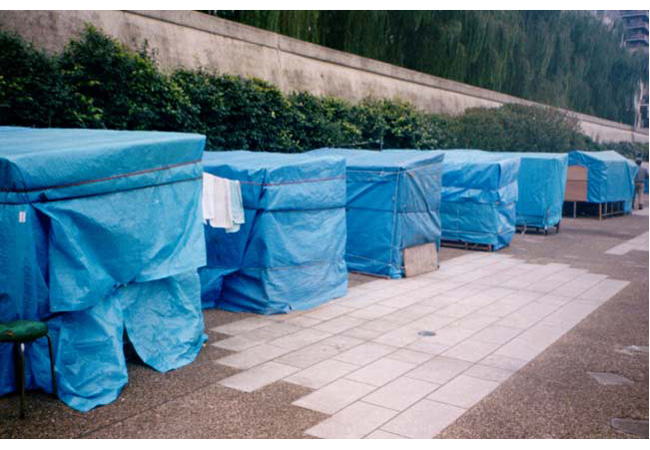

Consider a row of homeless peoples’ houses built on an urban street in Japan. If we look at these houses from an architectural perspective, we can discover many of the capabilities and elements in their architecture. These houses are built on a shoestring budget by diverting and recycling the rubbish thrown away on the street. In this respect, these houses are built out of the resourcefulnessof human nature, not by purchasing power. I call them “Zero Yen Houses.” At the present day, one may say that self-constructe
d houses do not exist in the dwelling area of the city. Almost all houses are commodities to be bought and sold. Moreover, from an ecological point of view, once a typical house is constructed its use does not change with time yet its building materials transform into garbage for the landfill. Under these condition as such, "Zero Yen House" gives some indication of the possibilities of future architecture. "Zero Yen House" is constructed with the materials mostly collected from the street. In other words, it gives a different perspective on discarded items thrown away as surplus materials of urban living. In addition, relative to the fact that current home-purchases generally cost millions of dollars, "Zero Yen House" costs just a few hundred dollars at most. The importance is that they are made by one’s own hand. This does not mean the dwelling is simply a box to live in. Instead, the dwelling is built as an extension of one’s own body. Therefore, the house shapes are each respectively different. No universal prototype exists for these houses, and this differentiation
from typical architecture is important. In the nature of things, I think that each dwelling is different spontaneously. "Solar Zero Yen House" is a dwelling I found built by an elderly man living along the Sumida River bank. Its construction inspired me as an architect to think about energy use for our future. A small solar panel, about the size of one mat, is installed in the roof of the dwelling, so energy is completely provided for. This demonstrates the possibilities for new architecture and new types of construction.
Zero Yen House is a primal (archetype) urban architecture, which is different from vernacular settlement construction we see around the world, and is it different from modern and contemporary architecture designed by architects.
kyohei sakaguchi www.0yenhouse.c
om
A Funny Thing Happened on the Way to Homelessness
 May 17, 2008 | 8:04:10 AM
"About us...O! where to begin!
"After Hurricane Katrina swept everything we own out to sea, a funny thing happened on the way to homelessness.
"We had a vision, a vision of helping thousands of people caught in the ebb and flow of life (and of the sea) who need portable, affordable, well-built, well-designed housing. A vision of things to come – on wheels.
"And we liked what we saw. And pronounced it good.
"And called it Fresh Start.
"Prior to Katrina we specialized in restoring beautiful historic homes. In fact, we lived in the oldest house on the entire Gulf Coast. It was called The Old Spanish Customs House, c. 1787. A great historical loss.
"But we have resurrected our building and home restoration skills to bring to you the most adorable little cottage-on-whee
ls. You might call it the ultimate “cottage industry.” Thank you. Please contact us so we can help you with a Fresh Start."

paraSITE concept homeless shelter feeds on AC systems


