7.31.2011

"San Francisco found a 56 percent decrease in emergency department visits by its chronically homeless population after providing them with permanent supportive housing."

Whenever I think about the costs  arising out of just one person's period of chronic homelessness (and there are conservative estimates that some 110,000 others are out there racking up similar dollar figures day after day, year after year as well) and how our nation collectively attempts to address them, I am reminded of the old Fram Oil Filters commercial:


It costs a typical American city about $40,000 on average when one person goes homeless in the city.

For 40K, we should be able to house, feed, clothe, and provide that person with enough disposable income to actually enjoy some of the finer things of life, compared at least to living in a cardboard box behind the local Walmart.

For 40 grand a year, a person should be able to rent a very nice apartment or buy a home in the $170,000 price range.  They should be able to eat healthy meals, purchase a car and maintain the upkeep, including registering and insuring it.  They should be able to even take a vacation and still have enough to put a few dollars away for savings, Christmas and a rainy day.  Finally, if they're careful, they can invest in their 401K and even retire with enough income that, when combined with their Social Security pittance, can avoid having to eat dog food in their golden years.

Said it before and will say it again until we decide to actually reverse the approach:
We're pennywise and pound foolish and we simply cannot afford to do business this way any longer....


Helping Chronically Homeless People Avoid High-Cost Health Care

Icon

FEDERAL POLICY BRIEF | 28 JUL 2011

FILES: PDF | 277 KB | 1 PAGE

Policymakers seeking strategies to manage health care costs often look at ways to reduce unnecessary emergency room visits and hospital stays. Frequently overlooked in this approach are community-based solutions that offset health care costs associated with homelessness.

The national estimate of people who were homeless in the United States on a given night in 2010 is 649,917. Roughly 17 percent of that number- or 109,802 individuals - are considered “chronically homeless.” Chronically homeless individuals are homeless repeatedly - four or more times in the past three years - or for long periods of time. They suffer from serious mental illnesses, substance abuse disorders, and physically disabling conditions. Typically uninsured, they frequently use (and may overuse) emergency room services to address complicated health needs exacerbated by living on the streets or in shelters. As a result, hospitals are among the safety net providers most affected when chronically homeless people lack access to primary care. Unnecessary costs and the lost opportunities to promote public health are borne by the entire health care system, particularly Medicaid and other public programs.

One policy alternative that is proven effective in reducing chronic homelessness, as well as public health care costs, is permanent supportive housing. Permanent supportive housing programs provide affordable housing accompanied by supportive on-site or community-based services such as mental health and substance abuse treatment, health care, and other ongoing supports. Housing placement and supportive services stabilize people experiencing chronic homelessness, so they can access care and preventive measures more appropriately, reducing the need for emergency room care and resulting public costs.

A number of states and cities have implemented permanent supportive housing strategies and have documented relative costs offset by this public intervention. Portland, Maine, reduced emergency room annual expenditures by $1,296 per chronically homeless individual given permanent supportive housing. Similarly San Francisco found a 56 percent decrease in emergency department visits by its chronically homeless population after providing them with permanent supportive housing. A mounting number of studies and documented success stories definitively find not only the cost effectiveness of permanent housing interventions in reducing emergency room costs, but marked success in reducing chronic homelessness.

For health policy, the implications are clear: Initiatives to reduce unnecessary hospital costs should enable local safety net systems to target appropriate interventions toward chronically homeless people. Appropriate interventions include health care and supportive services, such as those that Medicaid provides, that enhance the effectiveness of permanent housing solutions.

7.30.2011

Tea Party Tripe: "There is nothing worse than a stupid person in a position of power."

stu·pid  (stpd, sty-)
adj. stu·pid·erstu·pid·est
1. Slow to learn or understand; obtuse.
2. Tending to make poor decisions or careless mistakes.
3. Marked by a lack of intelligence or care; foolish or careless: a stupid mistake.
4. Dazed, stunned, or stupefied.
5. Pointless; worthless: a stupid job.


tripe  (trp)
n.
1. The rubbery lining of the stomach of cattle or other ruminants, used as food.
2. Informal Something of no value; rubbish.


When elected officials don't support those things that assist an individual on the bottom rungs of the socio-economic ladder in obtaining an education I know immediately that these officials aren't just ignorant but downright stupid, and there is nothing worse than a stupid person in a position of power.  


I owe my climb out of the depths of poverty to Pell Grants, Cal grants and the ability to obtain federal financial aid, all of which helped me overcome my 8th grade education (it was at that point that I had to find a job in order to support myself) and attend a state university.    


Every month, I send $318 dollars into the coffers of our federal government as I repay my student loan.   Every two weeks, the benefits of that higher education now put hundreds of dollars into the tax base of our local, state and federal coffers. 


Every day, I am able to help contribute to the vitality of my community because I can spend some "disposable" income at businesses around town.  


I help our environment because I can afford to purchase a newer vehicle, and I can afford to smog and insure it as well, protecting others from the dangers of uninsured motorists and pollution from older, more heavily polluting vehicles on our roadways. 


My higher education helped me end my addiction to heroin and cocaine, which made the drug war even less pointless than it already is and irrefutably proves - again - the efficacy of treatment over incarceration. 


Higher education made it possible to break the cycle of generational ignorance and poverty by allowing me enough income and acuity to recognize the importance of higher education for my children and actually provide it for them.


And a higher education also taught me how to analyze and critically think about the world we live in.  This in turn helped me to make informed decisions about how to participate in our Democracy, something our Forefathers felt was essential if this 'grand experiment" called America was to succeed.


Clearly, this is the benefit of higher education that instills fear in those who would attempt to manipulate and control us through misinformation, lies, deceit and hyperbole.  There can be nothing scarier to one in power than to have those being controlled suddenly become aware of the devious, scheming nature of their activities and behavior.


It's no wonder the Tea Party tyrants want to end Pell Grants.  Come to think of it, maybe "stupid" isn't the right word here.  


"Shrewd" and "treacherous" seem far more appropriate....


Tea Party Won’t Vote For Pell Grants For Welfare Queen College Students


just try to be born rich, is all they're saying.Frothing gremlin mosh pit “the Tea Party Caucus” is psychologically composed of the shrill, whiny kids on the playground who were already yelling “socialism!!!!” by age four when the teacher tried to give another kid a turn on the swings at recess, so here we are today with your adult-size whiny children complaining they won’t vote for John Boehner’s debt ceiling bill because it includes $17 billion in funding for Pell grants, small federal awards which average around $3,700 per college student annually and help over a quarter of college students. This is pretty much a steal compared to the $12,613 that the government spendsin Medicaid funds for an unplanned pregnancy, but there is that weird playground nightmare still playing over and over in the Tea Party collective unconscious, so money for college is just “welfare.”
From the Hill:
Rep. Denny Rehberg (R-Mont.) has compared Pell Grants to “welfare”.
“So you can go to college on Pell Grants — maybe I should not be telling anybody this because it’s turning out to be the welfare of the 21st century,” Rehberg told Blog Talk Radio in April. “You can go to school, collect your Pell Grants, get food stamps, low-income energy assistance, Section 8 housing, and all of a sudden we find ourselves subsidizing people that don’t have to graduate from college.”
Yeah, let’s skip all that and go ahead and do a nation of illiterate, starving, homeless pregnant people freezing to death. [The Hill]

Homeless Man Kelly Thomas' Death: "Nothing explains the gang-style murder committed by Fullerton cops"

Can't say much more than what's already been said by Carlos Miller (if you don't know who Carlos Miller is, I strongly encourage you to check him out and join his Facebook page) and Mike Riggs, other than to thank them both for raising further awareness of this injustice .


Regarding the brutality perpetrated upon Mr. Thomas, may he rest in peace, I would add only that not only is this a blatant hate crime, it's been done "under color of authority," which makes it all the more heinous and egregious.


I hope that Fullerton's citizens and police department do not allow this murder to go unpunished, and it is a fervent hope of mine that this senseless death be used as a catalyst to enact federal legislation making the killing of a homeless individual a hate crime under certain conditions. 


My condolences and deep sympathy are extended to the Thomas family.....


Homeless Man Dies After Being Brutally Beaten by Five Fullerton Cops

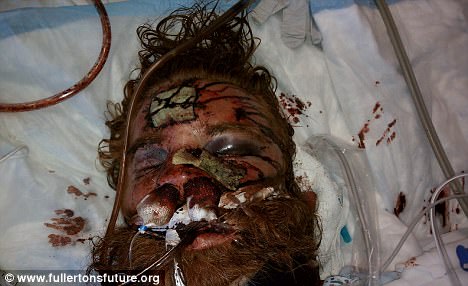
Kelly Thomas' father, a retired Orange County police officer, did not recognize his own son when he went watch him die at the UC Irvine Medical Center after police beat him into a coma on July 5. The officers were responding to a call about vandalized cars when they found Thomas, a homeless schizophrenic, and attempted to search him. Thomas' father says his son may have been off his meds, which would explain why he resisted arrest. Nothing explains the gang-style murder committed by Fullerton cops. 
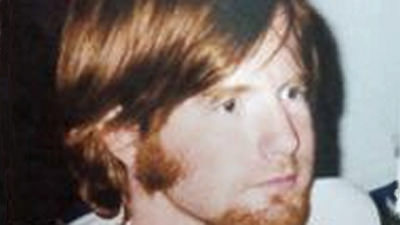
The top photo was taken at the hospital before Thomas died. The bottom photo is what Kelly Thomas looked like before he was brutalized. 
Kelly Thomas, a 37-year-old homeless man with schizophrenia, kept calling for his father as police beat and tased him repeatedly.
But his father, a retired Orange County sheriff’s deputy, was not around.
It wasn't until after Thomas slipped into a coma and was hospitalized with multiple injures that his father saw him.
And by then, it was too late. Thomas never recovered. The 135-pound man died five days after his run-in with Fullerton police.
Thomas’ father, a retired Orange County sheriff’s deputy, has asserted that officers used excessive force to subdue his son, who was unarmed, slight and of medium height.
After seeing his son's injuries and talking with witnesses, Thomas told the Register his son "was brutally beaten to death."
"When I first walked into the hospital, I looked at what his mother described as my son ... I didn't recognize him," Thomas said. "This is cold-blooded, aggravated murder."
Thomas, citing witnesses, said officers hit his son with the butts of flashlights even after he stopped moving.
He said his son was probably off his medication and didn't understand officers' commands.
A spokesman for the Orange County Coroner's office declined to discuss the case but said an autopsy of Thomas had been completed and the results forwarded to investigators.
Witnesses are asked to call Stan Berry, an investigator with the Orange County district attorney’s office, at (714) 347-8813.
Here's the video, which is mostly audio, but no less disgusting, nauseating, and heart-breaking for its lack of visuals: 

7.28.2011

"A staggering 55 percent of respondents said this was the first time they'd been homeless"

Two things about the story below that spring immediately to mind:
1.  The face of homelessness has changed considerably, and the problem of "first-timers" brings with it new challenges to those who perform outreach and case management.  This is primarily because until the vast majority of these new faces reaches "chronic" status, the resources available to help are slim to none.  There's really nothing worse to experience as a service delivery specialist than to tell people you can't deliver services to them.  


2. A recent article by the National Alliance to End Homelessness titled "No Increase in Homelessness Despite Recession" pointed to the 2010 Point in Time (PIT) count data to make this claim.  Most folks I know in this field, especially those who are working in direct contact with the peeps on the streets, scoffed at the claim and countered that not only was their an increase in the population, it was a pretty dramatic increase to boot.  


Now it could very well be that the 2010 PIT count was at least somewhat representative of the current state of homelessness in the country, although I doubt it because we all know these numbers are nothing more than guesstimates, and not very good guesstimates either, the reasons for which being something I've written about previously in this blog on several occasions.  But it's far more likely that the PIT count dramatically under-reported the actual numbers right about the same time that the floodgates on those experiencing homelessness - especially those "new faces" of homelessness - were unleashed.  


I would wager that Rohnert Park is indicative of the majority of other cities and towns around the country and I suspect that over the next couple of years, we'll see this kind of dramatic increase is going to become the norm, rather than the exception.  


I'll also wager that it'll be even harder to accurately count folks in the future, as efforts by local law enforcement and downtown partnerships put tremendous pressure on the homeless population not to hang around in downtown areas.  These folks will scatter and disappear into the burbs, the camps and the woods, and we'll miss more and more of them simply because we cannot find them any more.


On the plus side - if there is a tarnished silver lining at all - by the time we do find and count them, they'll have achieved the dubious but vaunted (by direct service workers, anyway) status of "chronically homeless" and we actually might be able to provide services for them.  Unfortunately, by that point we'll need far more services to assist with the physical and mental illnesses, substance abuse, ruined credit, criminal records and the myriad other issues and problems that accompany the condition of homelessness.  


Pennywise, pound foolish, and woefully off-base in our assessments of the situation.  Pretty much describes just about every aspect of government involvement in anything.  


Aren't you proud of your elected officials?


Report: 40 Percent Increase in Homelessness in Rohnert Park, Countywide

Recent data show that 55 percent of people counted were homeless for the first time, 74 percent were living unsheltered and nine percent were veterans.


Rohnert Park's documented homeless population increased from 97 in 2009 to 446 in 2011, or 40 percent, according to a final homelessness study released this month. That number comes to 1 percent of the city's total population — higher than the countywide average.
The report — compiled by the Sonoma County Continuum of Care, a homeless outreach program run by the county — is based on a boots-on-the-ground count of homeless people conducted in late January.
Organizers attributed the surge to better counting methods and fallout from the Great Recession.
Data show that Rohnert Park is no different than other cities in Sonoma County — countywide, the homeless population was on track with the city's, also at 40 percent.
Best estimates put the actual number at 12,565, or 2.6 percent of the county's population, which is up between 25 and 30 percent from 2009. Cloverdale, Healdsburg and Windsor's homeless population swelled to 421 from 284; the south county's (including Rohnert Park, Cotati and Petaluma) went from 637 to 1,025 collectively; Sonoma's increased to 183 from a mere 16, and in Santa Rosa, the uptick was almost double, at 2,320 from 1,487.
A staggering 55 percent of respondents said this was the first time they'd been homeless, and 48 percent reported a "disabling condition," including physical disabilities, substance abuse and mental illnesses.
More than 600 homeless individuals were interviewed at length following the count in an attempt to gather more detailed information.
Based on 617 profiles, 66 percent were males and 33 percent were female, 64 percent were white and the majority were between 31 and 60 years old. 
Of Rohnert Park's homeless, fewer than 20 percent were sheltered, according to the report. The 78 who did have a roof over their heads were living at Vida Nueva, a transitional housing facility run by the Committee on the Shelterless (COTS).
Editor's note: The homeless census was done January 28 in conjunction with the U.S. Department of Housing and Urban Development, Sonoma County and Applied Survey Research.
What does the increase in homeless people mean to you? Tell us in the comments.

The "number of Iraq and Afghanistan vets on the streets has soared more than five-fold since 2006."

So here's the scary part of this fivefold increase: When vets came home from Viet Nam in the mid 70s, generally speaking it took the majority of those vets who ended up homeless about 9 years on average to spiral downward into that situation.  I'm generalizing here, of course, but the best data available points to this as a timeframe.


Conversely, the OEF/OIF vets coming home today are spiraling into homelessness within 18 months to two years, on average.  Of course there are some who hit the bricks faster, but again, generally speaking, we're talking about a relatively rapid descent from active duty discharge into homelessness.


Now, what should give everyone pause and start the guts to churning is this: some 2 million plus veterans have now served in the Iraq and Afghanistan wars.  Again generally speaking, veterans have made up anywhwere from between 20-30 percent of the population of peersons experiencing homelesnsess. 


If we apply this ratio to the number of vets who will be coming home soon, we should be shitting bricks right about now, because conservatively speaking, we're looking at a potential influx of about a half million newly homeless veterans into our towns and cities. 


These vets will return home to a "support" system already heavily overburdened and underfunded.  Additionally, most of the agencies that will make initial contact will most likely NOT be affiliated with the VA and for the vast majority of community-based service deliverers, they will know little about military culture and how to serve the vet, and even less about how to effectively access the VA and hand off clients in a way that will end with successful transfers into the VA.


One more thing here that needs to be pointed out here is the fact that at least one of the Republican debt ceiling plans to cut spending (funny how they never thought about this when they raised it 18 times under Reagan and another 9 times under Bush) suspends VASH funding for one year.  I've written previously about this and it's a stupendous outrage perpetrated on the backs of those who've served with honor and dignity, not to mention yet another affront to sensible Americans seeking balanced solutions to a problem that was primarily created with the Bush tax cuts initiated during a period of war, something that has never happened before in the history of our nation.  


It occurs to me that Vets are often provided some of the best equipment in the world to face the challenges of the battlefield.  Yet, upon coming home those who sent them off to war in the first place will have provided them with just about nothing to survive the biggest battle they'll ever face, surviving in the good ol US of A.  


Pathetic indeed....

Our take on: Homeless veterans & Debt ceiling gridlock

Homeless heroes
First the good news: America's homeless veteran population, which crested at about 400,000 in 2004, has plunged to 135,000 today.

The tragic news is that the number of Iraq and Afghanistan vets on the streets has soared more than five-fold since 2006.

VA officials point the finger at the ailing economy and multiple deployments. As many as 33 percent of homeless vets saw combat. Many return with mental shrapnel that sabotages their lives.

To help, the VA's spending millions to house at-risk veterans. Good.

Still, like a bugle call, the ominous spike in homelessness among recently returning veterans should remind the VA that it must stay vigilant in meeting an almost-certain burgeoning need.

More gridlock
Can't Congress get anything done anymore? It's not just its appalling inability to resolve the debt ceiling crisis (which it helped foist on the nation in the first place).

Now Congress has managed to bring much of the Federal Aviation Administration to a standstill. Air traffic controllers and security personnel are still working, thank goodness. But nearly 4,000 FAA employees have been furloughed, and many airport construction projects delayed, because Congress last week couldn't agree on legislation to keep the entire FAA operating.

Locally, needed expansion and resurfacing projects at Orlando's two commercial airports could atrophy, mirroring the inertia of Republican and Democratic congressional leaders who can't — or won't — move their way around the labor issues and subsidies for rural airports that separate them.

Pathetic.

7.25.2011

"I know that when John (Puderbaugh) died, he died in his own home. He was warm, he was safe, he died with dignity."

I never understood the mentality of those who argue against collaborating w cops to help identify and target those experiencing chronic homelessness in our towns and cities.  


Sure, I get that it can be construed as "cooperating" with the cops, but there's a big difference between collaboration and cooperation, kids, and it doesn't take long for folks on the streets to sort out what the outreach worker or case manager is really doing as they meet w police.


A quick example: several years ago, immediately after Nashville's annual Point in Time count, a high-ranking government official directly involved in actual count and the efforts to end homelessness in the greater Nashville area was approached by police and asked to point out where the homeless camps were located.  The story goes that this individual flew w local police in a chopper, pointing out camps they'd discovered during the count, and shortly after this flight, police began systematically dismantling each of the camps they'd been led to.


To be fair, the individual who led police to the camps did so "unwittingly," and argued that police asked and this person didn't think the cops were going to take this kind of action.


Frankly, I'm not sure this "flight" ever took place, but I know that this individual's credibility within the homeless community was forever damaged, because it appeared that it was indeed a "cooperative" effort. 


As another counterpoint example, enter Lt. Andrea Swisher, who works with Nashville's police and for a long time was the day shift supervisor of the beat cops in the downtown area.  Lt. Swisher came to a meeting of outreach workers one day years ago, laid her cards on the table and stated that whatever we were doing on the streets to assist the homeless wasn't working, what the cops were doing was making it even worse, and she wanted to know who would join with her to figure out how to make the system do what it was supposed to; get folks into housing and end homelessness in the Nashville area.


NO ONE wanted to work with Swisher.  Except me.  I wasn't afraid to be seen with her, because I knew that I could trust her to do what she said, without a hidden agenda driving her towards an ulterior motive.


And I knew that once folks on the street began to see results from their interactions with Lt. Swisher, her credibility would skyrocket, the homeless community, police, and the larger community would all benefit from the improved relations, and it'd be a win-win for all of us.


Which is exactly what it turned out to be, for at least three years.  During that time, Swisher kicked a lot of good ass, helped many many people through very tough times, gave out of her own pocket more times than I care to count to assist people who were trying to obtain housing, and who never forgot about those everyone else had long ago wrote off.  


Everyone knew their place with Swisher, too.  They knew that if they were committing a real crime (and not those ridiculous "quality of life" crimes), she was gonna bust em.  But she did so with a respect not typically found in most cops, and so long as you never forgot that her job first and foremost was to enforce the laws of our community, you could establish one helluva great relationship with one tough as nails cop who would "have your back" no matter what situation you found yourself in.  


Swisher tried like hell to make some changes in the department, and it was a continual uphill battle for her.  She  was finally transferred to another department and left the streets in her capacity as a beat cop.  


The loss is still being felt throughout the community.  


This is not to say there aren't other great cops working the streets in Nashville, and officer Cruz, as well as a number of other motorcycle and beat cops, stand as a testament to the true "Protect and Serve" ideology of police departments worldwide.  


But the loss of that contact, of a cop who could be trusted - and I mean really trusted - who knew the people better than just about anyone else, who had a lot of info stored in her head and had the pulse of the community under her fingertips, that loss is a huge blow to our community and to those who must endure night after night on the mean streets of Nashville alone, unprotected, exposed and vulnerable.


Not all the cops out there are bad and some still take their duties to protect and serve damned seriously.  I can't tell them how much some of us appreciate that, and on behalf of all those who've been helped by cops when everyone else had abandoned them, I share this heartfelt "Thank You, Officer" for them.....


Long Beach police program seeks to help, not jail homeless

By Tracy Manzer, Staff Writer


Long Beach Police Officer Joe Seminara helps Steven Bozier pick out new clothes at Christian Outreach on Nov. 24, 2010. Seminara is one of two officers that work with the city's sizable homeless population, helping people on the streets find shelter, and often permanent housing, and navigate all the small things most of take for granted, such as handling legal matters and getting city services when you don't have a permanent address or a credit history. Seminara is retiring Thursday. (Jeff Gritchen / Staff Photographer)
LONG BEACH — John Puderbaugh was the poster child for the homeless.


His was the traditional image of a transient - an older man, unkempt with long scraggly hair and dirt ground deep in his pores, a face criss-crossed with wrinkles etched by age, alcohol and a hard-scrabble life.


Long Beach Police Officer Joe Seminara saw Puderbaugh on the streets countless times.


While many people pass a transient like Puderbaugh without notice, Seminara was keenly aware of him.


That is because Seminara is one of two officers first tasked with running the Police Department's Quality of Life program in 2007, making it Seminara's job - until he retires Thursday - to work with thousands of homeless individuals living in Long

John Puderbaugh in his new apartment on Oct. 28, 2010, in Long Beach. Long Beach Police Officer Joe Seminara helped Puderbaugh move out homelessness through LBPD's Quality of Life program. Puderbaugh died earlier this year, and Seminara is retiring Thursday. (Jeff Gritchen / Staff Photographer)
Beach. It took hundreds of visits from Seminara to gain the wary schizophrenic's trust.
Seminara would find Puderbaugh wherever he was camped and take small gifts of water bottles, cigarettes, food, blankets, or socks to ease the conversation.

With each visit they talked and he learned about Puderbaugh's family, where he grew up, where he went to school.

Seminara never gave Puderbaugh a ticket for sleeping in the open or hassled him about the alcohol that helped keep the symptoms of Puderbaugh's raging schizophrenia at bay.


me about it, I had to wait. I had to work on him. ... It took more than a year."


"You could tell he needed to get inside," Seminara says. "He needed a doctor, he needed medication, but to get him to a point where he trusted me to do that and where he could talk to others.

Puderbaugh finally relented and let Seminara get him into permanent housing.

It took days just to straighten out the paperwork for years of social security and federal general relief money Puderbaugh had pooled but hadn't touched.

Then there was the adjustment for Puderbaugh to living indoors.

Puderbaugh's mental illness made enclosed spaces and being around people torture. Now he was trying to live in a large apartment complex in bustling downtown Long Beach.

Seminara explained all that to the apartment manager when Puderbaugh was found sleeping outside a few times.

The officer also took Puderbaugh to his doctor appointments, helped him keep his prescriptions filled and made sure Puderbaugh ate regularly.

Puderbaugh still went back out to the streets. Seminara often found him visiting friends. But he did take to his new stable home life, showing off his spotlessly clean apartment to a Press-Telegram reporter and photographer last year.

One night a few months ago Puderbaugh died in his sleep. He suffered a heart attack and his death hit Seminara hard.

"Some people ask me if getting him inside might have had something to do with it," Seminara says. "Like once he wasn't on guard all the time he could relax and he died."

As Seminara considers the thought, his normally sunny disposition clouds over and his typical broad smile fades.

"I don't know if that's true," Seminara adds. "But I know that when John died, he died in his own home. He was warm, he was safe, he died with dignity."

Before the Quality of Life program and his time with people such as Puderbaugh, Seminara had a typical view of the homeless, he says.

As a policeman he is "fairly conservative," and prior to this work he thought the homeless didn't want to work and chose to live that way, he says.

"It's not that simple," Seminara says. "People are falling between the cracks, they get lost and caught up in this horrible cycle, and you don't think that happens because this is such a great country, but it does."

Working this beat for nearly five years has proven that to Seminara and changed him, he says.
"I think it's made me a better person ... it's humbled me a lot," Seminara says.

A changed man

The transformation is obvious.

Unlike most police officers who use squad cars, Seminara cruises around in a slightly beat up, 1990 s-model minivan.

That way, there's more room for his stash of new socks, snacks, water bottles and cigarettes, and the child car seat needed for transporting homeless families.

It may not look like much, and that's the idea, he adds.

"It doesn't intimidate people the way a black-and-white (squad car) does," he says.

Seminara wears a uniform, but in his pocket is a small stack of pre-charged gift cards - paid for by the Long Beach Police Foundation - that he uses to buy food, prescriptions and even bus tickets to return people to long-lost relatives inside and outside of California.

Then there's his lingo.

Most cops talk in code, but Seminara's is different.

Instead of 187 s and 265 s, he deals in SSI and GR, which stand for Supplemental Security Income and General Relief.

Learning his way around all the social programs and the rules that come with such benefits wasn't easy. He likens that period of the job, the first few weeks, to "taking a crash course in graduate social work."

It required a lot of hours spent with staff at the Multi-Service Center for the homeless, St. Mary Medical Center and Long Beach Memorial Medical Center, as well as a number of other local organizations such as Christian Outreach in Action, the Long Beach Rescue Mission and The Villages at Cabrillo transitional housing.

As Seminara learned from local social workers, doctors, nurses and pastors, they learned from him.
One key lesson: a police uniform in the lobby of a social security office gets much faster results than a call from a social worker, he and several others say wryly.

"That badge works," laughs Lucy Hayes of the city's Multi-Service Center. "I told him I need one ... before he retires."

And working with people like Hayes helped Seminara gain credibility.

"He had to prove himself, because I can't do outreach work if I'm being labeled a rat or a snitch," Hayes said. "When they saw that he could be trusted, they came around."

Costs of homelessness

Though Seminara retires Thursday, he hopes his work over the past several years, the work that so drastically changed his world view, will trigger a similar evolution in law enforcement culture in the LBPD and beyond.

It has already helped launch a similar program at the Long Beach Police Department, called the Life Re-Entry program, with teams of officers assigned to all four divisions to help recently released parolees and probationers.

At the core of these programs, Seminara and police department leaders such as Chief Jim McDonnell say, is the need to address the staggering cost of homelessness and incarceration.

There have been a multitude of studies across the nation, most geared toward the cost of medical services, that show just how expensive it is to have a booming homeless population.

"The Homeless Cost Study," an oft-cited collaborative effort between USC's Center for Community Health Studies and the United Way of Greater Los Angeles, found the total cost of public services spent on four individuals - that included one Long Beach transient - during two years living on the street was $187,288.

The cost of public services dropped by more than $20,000 per person during two subsequent years spent in stable, permanent housing. In particular, the cost to the public for the Long Beach man's needs dropped by more than $44,000 with such housing, the study found.

A local survey showed more than $5 million was spent last year in emergency room visits, hospital stays and fire department/ambulance services for just 350 homeless people in Central Long Beach.
Among the downtown Long Beach homeless, 32 percent visited area hospitals three or more times in the past year.

A number of studies also show the effect of homelessness on the state and county's cost-crippled legal system.

According to the Los Angeles-based Corporation for Supportive Housing, state incarceration costs $40,000 per year, or $110 per day, per inmate.

More than 50 percent of homeless people in the region report a history of incarceration. Parolees who are homeless are 23 percent more likely to return to prison than parolees with stable housing, according to that study.

Costs for Los Angeles County jail inmates are calculated at more than $50 per person, per day.
Dr. R. Jan Gurley, author of Doc Gurley's Urban Health Beat, noted that while the California Department of Corrections and Rehabilitation (CDCR) doesn't track the number of homeless it receives, an assessment tool launched in 2008 to predict which inmates were likely to become higher-risk parolees estimated 39 percent of inmates were at high risk of "residential instability."

Nowhere to go

Every day, Seminara says, he sees the reality of all those statistics play out on the streets of Long Beach.

"There are a ton of programs out there to help people, but there isn't anything to coordinate all those programs," Seminara explains. "And there isn't much to help people when they first become homeless and the general relief and social security hasn't kicked in."

The greatest need, he says, is with the mentally ill and those with serious medical problems.
Seminara is called regularly by local shelters when someone shows up on their doorstep, freshly released from a hospital but in no condition to care for themselves and with no one or nowhere to go.

Seminara has become a master at getting such people in sober-living facilities, where he uses donations from the police foundation to pay for their food and to pay another resident to cook and care for the person.

He can tell you which sober-living facilities - a new term for what was once deemed a half-way house - are "clean" and which ones to avoid.

Seminara also knows the best detox facilities in the Southern California region. He's driven people as far as Riverside County to get them into a bed, and with a phone call can find an emergency shelter bed most nights of the week.

It isn't all take, either.

Many of the organizations call Seminara when they need help - usually with transporting someone who needs a different agency, sometimes if they need his law enforcement pull with another government agency and occasionally if a shelter has someone completely out of control.

However, arrests are extremely rare. They have to be, Seminara says, to gain and keep that trust.
"An RN from the Village told me, 'Police do a good job protecting, but you don't do a good serving,'" Seminara recalls. "I looked around, and I had to admit she was right."

Part of that, he says, may have been lost when police departments stopped using beat officers who walked every inch of their neighborhoods every day and who knew everyone who lived and worked there.

A large part part of the issue is understanding that things have changed and that arrests aren't the only solution, he says.

However, looking for creative solutions when you find someone violating the law because they're homeless isn't taught in most academies.

People at the shelters and programs he works with agree. Many were panicked by the news of his retirement.

"When I first heard, I said, 'Oh noooo,'" Pastor Jeff Levine at the Long Beach Rescue Mission says. "We talk to Joe daily. Sometimes many times a day."

Seminara assures that he has been training two new officers for the past four weeks on his beat. He's confident they understand the purpose of the program and hopes it will grow to include more officers, at least one team in each division.

"It's a good program, Chief McDonnell supports it and we get a lot of support from the (Long Beach Police) Foundation and St. Mary's and Memorial," Seminara says.

The financial and moral support is due to the fact that the program works. It saves money for the city, county and state by avoiding the mindless cycle of citations and expensive jail stays, Seminara insists.

"And these are people, these are human beings," he says. "It's the right thing to do."
tracy.manzer@presstelegram.com, 562-499-1261.

The cost of homelessness and incarceration

2,490 Homeless were in Long Beach in 2011.
254,000 Homeless were in Los Angeles County in 2011.
1,193 or one-in-25, of Los Angeles County parolees are homeless.
More than 50% percent of the homeless in the Los Angeles region have a history of incarceration.
Homeless parolees are 23 percent more likely to go back to prison than parolees with stable housing.
A 19% percent drop in homelessness was seen in individuals with serious problems - jail histories and substance abuse issues - who received only minimal assistance in the form of temporary housing.
$210 is the average cost per inmate per day in Long Beach jail.
$129 is the average cost per person per day in the California prison system.
$54 is the average daily cost per inmate in the Los Angeles County jail system.
Sources: Government agencies and academic studies


Smiling does a body good

Democracy Now Livestream