As Nashville continues its struggle against lack of affordable housing, outreach specialists and critical services needed to serve the most vulnerable and marginalized in our community, some agencies and advocates stand out from the rest in their tireless effort to bring whatever they can to the table (no pun intended) in order to make life a little easier for those who must endure it homeless.
As I wandered the most recent camp facing closure last week and spoke with residents/friends I've known for many years now, a couple of things were immediately apparent. First, while there were a couple of folks down at the camp trying to provide some outreach, the lack of coordinated, skilled and full-time outreach specialists trained in MI and specializing in person-centered, trauma informed outreach with a housing focus means people will continue to suffer needlessly. Second, the issue of housing, or more specifically the lack thereof, especially for people who present challenges to traditional units, continues as a glaring reality for us as a city. Most of the folks at this particular camp are transplants from the original Tent City, which closed on May 5th, 2010 when flood waters along the Cumberland River did what city officials could not; empty the camp completely and wipe out all standing structures. As the waters receded, police began enforcing the "no trespassing" order with a vengeance, arresting and jailing anyone who dared set up a camp site in the area.
The bad news, as far as I'm concerned, is that these two things - lack of outreach and resources - were also the same problems facing folks in the original camp back in the pre-flood days of 2009 and 2010. Unfortunately for those who remain on the streets, neither has improved and frankly both have worsened considerably since 2010.
I can unequivocally state here that if it had not been for Ingrid over at Open Table and Denis from Operation Stand Down, camp residents would have been in far worse shape than they were, since without them, no one would have even known the camp had been ordered to close.
Perhaps the most frustrating thing about this whole issue is that even with the confirmation that this camp was closing, the response I perceived from those who are charged with finding solutions to these kinds of issues was a hohum sense of resignation that the folks at the camp were "un-housable" and therefore did not warrant the expenditure of any resources whatsoever.
I don't mean to disparage anyone working in any one of these agencies because I know that for the most part, provider hearts are definitely in the work they're doing. But I know the sense of frustration many of them feel; not only are so many of the "available" programs out of reach for many of the area homeless because of the eligibility requirements, we've also been pushing this damned "affordable housing" boulder up a mountain that would embarrass Everest with our noses and we've been crushed so many times by the backward slide that many have simply given up pushing.
As governmental budgets shrivel and cuts to funding for agencies continue, we are forced to operate in crisis mode ourselves, reacting to the very worst of the cases instead of trying to proactively end homelessness before folks have so many challenges stacked up on their backs that it's neigh impossible to help them.
It's a never-ending battle that saps the strength, the commitment and the dedication of damned near everyone involved.
That Open Table continues to fight back tirelessly should stand as a testament to the rest of us that we cannot let the disinterest, the lack of funding, the ignorance. and the myriad other issues facing us destroy our own commitment to the cause as we work to end homelessness.
My deep appreciation goes out to Ingrid and the folks at Open Table for staying on course, no matter what everyone else may or may not be doing.
My colleague and current director of the SOAR program at Park Center Corey Gephart and I will be presenting a short piece on the need for outreach/services during our upcoming Nashville Metropolitan Homelessness Commission meeting (3/2 at 9a), I'm hoping to highlight the challenges facing us as service providers and then promote the return to the primary focus of the Commission: making affordable housing a reality for the people of Nashville. There's no doubt whatsoever that we are in desperate need of it and it cannot come too soon.
Most folks around these parts will probably remember the protracted battle to first save the largest homeless encampment in Nashville, then to extend the closing deadline to try and provide services and resources to the 100+ residents living there, some for a decade or more.
Mother Nature did what police, city officials and the business community could not; the historic flood that occurred in May, 2010 put that camp some 20 feet under water, pushing out residents, who entered Red Cross emergency shelters as they waited for the flood waters to recede.
Those who could got out of Nashville, those who couldn't moved to where they believed they had the freedom from persecution and hassle by law enforcement.
Unfortunately, it didn't last, and now they are forced to move again. With each move, they are pushed further outward, into suburbs, away from services, and deeper into isolation.
On the basis that a well-informed citizenry is critical to choosing the right leader, I submit the following material addressing "safety nets" for the poor to you for your analysis. Unfortunately, I long ago recognized that whatever your analysis might determine, it will most likely make absolutely no difference.
There's very little action beyond occasional lip service those of us on the lower rungs of the socioeconomic ladder can count on from any of the current crop of "leaders" governing our country. It has become increasingly clear to me that this is because we don't really operate under a democracy, or a republic, although many continue trying to tell us we do. We are governed by a bastardized version of both, a "representative democracy," which ultimately ends up allowing those with deep pockets to receive substantially more "representative" involvement than those of us with shallow or empty pockets receive.
American politics, like just about all politics, has always been controlled by those with the means to control it. "Control" here is really just a codeword for M O N E Y.
Granted, it wasn't always as terrible as it is now, but the pendulum of big crumbs versus small crumbs given to those on the bottom has definitely swung back and forth over the last couple hundred years here in the US.
But I can also clearly remember when I felt like I had a shot at entering "middle class." This "feeling" remained with me all the way up until around the mid 80s, when something odd happened. From that period forward, my weekly wage didn't increase much at all, but prices for things did like crazy. From candy bars to chicken legs, dishsoap to gasoline, everything I needed to survive began an inexorable price climb that continues to this day. Unfortunately, wages that used to climb in some relation to the cost of living ceased their increase.
Meanwhile, it was somewhere in the early 90s that I recall strange things beginning to occur with our public institutions. Schools began telling us how hard it was for them to keep textbooks in the classroom. Libraries began closing or dramatically curtailing their operating hours. Police, fire and emergency services began to tell us they were laying people off, or couldn't afford new equipment to operate effectively.
Roads, bridges and transportation in general began falling into real disrepair right about the same time that gas prices began going through the roof.
Jobs were disappearing everywhere. Entire cities were on the verge of collapse. Those who could move did, leaving those who couldn't to fend for themselves while cash-starved municipalities struggled even more as they lost the biggest contributors to their tax base.
Conversely, jails and prisons were enjoying a boom-time, remaining packed to overflowing, while local and state governments spent lavishly on building more to address demand.
What the hell happened to my country I wondered as I struggled to hold down two minimum wage jobs I had to beg to obtain?
I began paying more attention to politics, naively thinking that by understanding the issues and voting for the right person to represent me, I could help change the disastrous course our big ol ship was on. Didn't take me long to realize I wasn't alone and that there were hundreds of thousands, then millions, who, like me, was wondering what in the hell happened to make life so damned miserable for so many of us?
Then I began to realize that most of the "candidates" available to us weren't "for" us at all. Even those who claimed to be representing us were so far away from what we thought was needed that those of us who did vote began to hold our noses when we stepped into the booth, figuring that we'd choose the lesser of two evils, since things were so bad that maybe by choosing the less less-palatable candidate, things would at least stabilize and we wouldn't continue a further slide into the poverty abyss.
As things got worse in our communities, people became very scared. Fear has a strange way of manifesting itself, and folks began looking for scapegoats, to "God," to emotional ties to potential candidates who, although not always aligned with their best economic interests, helped vindicate or support a particular point of view, such as the "right to life," or allowing gays to marry. By using these "hot-button" issues to garner support, views and individuals previously considered "extreme" became more "mainstream," at least to some.
Then some crazy bastards flew a couple of planes into one of the "symbols of America" and full-on insanity within the national political theater became the norm.
Things once thought never possible here in the "land of the free" became law as people willingly gave up the very rights our Founding Fathers tried desperately to clad in stone in the Constitution.
Folks with frankly ridiculous assumptions about how to run a country squandered the wealth of our nation, led us into wars with countries that had never done anything more than curse at us from their canoes on the shores of a distant ocean or sea, and ended up pissing off more than a billion people, all who now look at our shores with missiles and hate in their eyes.
Our "leaders" capitalized upon this hate by fearmongering to us on a daily basis, causing many to quiver in their shoes as they gave up more and more of the Rights our Founding Fathers fought so damned hard to provide them. Those "Leaders" funneled more than half of our collective wealth into a military machine, arguing vociferously that it "protects" us, provides magical jobs, and now that military has become our nation's largest employer. Coincidentally, it also provides the most benefits to the people of our nation. Think this through and you'll understand the point I'm trying to make, if you don't already.
Did the 80's really initiate these things, or were they in place and fomenting long before, with the 80s just being the catalyst needed to set it all into motion?
"David Stockman bragged, back during the Reagan administration, that the goal of Republicans was to rack up such a huge federal debt that Democrats would never be able to push forward the "socialist" programs that Americans want, like stable Social Security and single-payer national health care. He called it "starving the beast." Grover Norquist suggested it would force government to become so small it could be'"drowned in a bathtub,' leaving the corporations in charge. George W. Bush actually, finally, made it happen."
I don't mean to single Reagan out as the initiator of the "Evil Empire" he so eloquently argued he was fighting, Yes, the finger is pointed at a Republican as the tipping point, but that Republican could never have succeeded without direct complicity from the "opposing" Party standing at their side.
This is not a Republican or Democrat issue, it is a Republican and Democrat conspiracy to remain in power by appeasing those who can ensure the status quo.
Since most of us will never reach the level of wealth needed to insert ourselves into the power structure, the pathetic fists pounding on a closed iron door to the Halls of Power are barely noticeable inside those halls, and would fall on deaf ears anyway, since we have nothing to offer but cannon fodder for the next war.
Doesn't mean I'll give up the fight, but I long ago long lost my Locke-inspired belief in the "Moral Code of Government," exchanging it for the much more appropriate Hobbesian "Materialist View of Human Nature" and his understanding of "fear as the determining factor in human life."
For my critics and the cynics of this particular piece, I applaud you for keeping the dream of a moral and compassionate government and society alive. I would greatly enjoy being proven wrong, and I'm thrilled you continue to have faith in the human race. I just wish there were more of you.
JEFFREY BROWN: Now, wealth, poverty and politics today.
For several weeks, much of the Republican presidential campaign seemed to focus on the subject of wealth, specifically that of Mitt Romney and the taxes he did or didn't pay. MITT ROMNEY (R): Will there will discussion? Sure. Will it be an article? Yeah. But is it entirely legal and fair? Absolutely. I'm proud of the fact that I pay a lot of taxes. JEFFREY BROWN: The wealth focus came amid a national conversation prompted in part by the Occupy protest movement, which put a spotlight on economic inequality.
President Obama took up the theme in his State of the Union address last week. PRESIDENT BARACK OBAMA: We can either settle for a country where a shrinking number of people do really well, while a growing number of Americans barely get by, or we can restore an economy where everyone gets a fair shot, and everyone does their fair share, and everyone plays by the same set of rules.
(CHEERING AND APPLAUSE) JEFFREY BROWN: Now the dialogue may be shifting from wealth to poverty.
Romney drew fire yesterday after he said this on CNN, explaining his focus on the middle class. MITT ROMNEY: I'm not concerned about the very poor. We have a safety net there. If it needs repair, I'll fix it. I'm not concerned about the very rich. They're doing just fine. I'm concerned about the very heart of America, the 90, 95 percent of Americans who right now are struggling. JEFFREY BROWN: In Las Vegas today, Romney's Republican rival, Newt Gingrich, accused him of dismissing the poor. NEWT GINGRICH (R): I really believe that we should care about the very poor, unlike Gov. Romney.
(LAUGHTER) NEWT GINGRICH: But I believe we should care differently than Barack Obama. Both Gov. Romney and Barack Obama seem to believe that a -- quote -- "safety net" is all the poor need. I don't believe that. What the poor need a trampoline, so they can spring up and quit being poor.
(CHEERING AND APPLAUSE) JEFFREY BROWN: And the president worked the issue into remarks at the annual National Prayer Breakfast in Washington. BARACK OBAMA: It's also about the biblical call to care for the least of these, for the poor, for those at the margins of our society, to answer the responsibility we're given in Proverbs to speak up for those who cannot speak for themselves, for the rights of all who are destitute. JEFFREY BROWN: The issue may resonate this election year more than most, as poverty numbers rise and millions of Americans remain unemployed.
And we explore some of these issues now with Angela Glover Blackwell. She's the founder and CEO of the advocacy group PolicyLink. Lawrence Mead is professor of politics and public policy at New York University. And Barbara Perry, a senior fellow in the Presidential Oral History Program at the University of Virginia's Miller Center.
Angela Glover Blackwell, I will start with you. A general question first: How serious a problem is poverty in America today? ANGELA GLOVER BLACKWELL, PolicyLink: Poverty is a huge problem. It's a problem for the people who are in it and it's a problem for the nation -- 15 percent of Americans live below the poverty level, highest number since 1993.
And 44 percent of those live below half of the poverty level. That means for a woman with two children, that's less than $9,000 a year. On top of that, we have millions and millions of Americans, 127 million, who in three months of no job would live in poverty.
Poverty is a huge issue, it's getting worse, and it should be very troubling to all of the American people, not just those who are living in poverty. JEFFREY BROWN: All right, well, Lawrence Mead, you were an opponent of the welfare reform in the '90s. You don't hear much about poverty in our politics today. How would you frame the problem? LAWRENCE MEAD, New York University: Well, poverty is a different problem from those that have gotten most of the attention. It's not primarily due to unemployment or inequality.
Those are concerns that affect the bulk of the population and they affect some poor people. Poverty has grown largely due to economic conditions, but it doesn't follow that most of poverty is due to the economy. That's really not true. Most poor adults are outside the economy.
They're simply detached. And they don't say that the fact that they're not working is due to the fact that they can't find a job. That's seldom the case. It's usually other factors in their private lives that make it difficult for them to work.
Now, I don't give up. I think we should take steps to make sure that they, in fact, go to work. And that's what we did in welfare reform. I think we should also do it for non-working men of low income. Most of them are not employed either, and we need to do something about that. And certainly the economy makes it harder to do, but it's still quite possible.
Jobs are usually available. The main problem is to mobilize people to actually get up and work regularly. JEFFREY BROWN: All right, so, Barbara Perry, there was that remark from Gov. Romney yesterday starting to bubble up into the political conversation. As someone who studies presidential history here, what strikes you about this moment as we think about poverty and politics? BARBARA PERRY, University of Virginia: Well, I think it's a moment that in many ways repeats a cycle in our country's history that goes back to our very founding.
And that is that the founding fathers were aware of economic inequalities even at that time. And it has followed through and has often been kicked off, these various cycles, by traumatic upheavals. And certainly 2008 was a traumatic upheaval in our economy. And so I think the disparities that people see -- and I think the hearts are in the right place of both Lawrence and Angela -- they may have different approaches to the problem or see different political issues related to it.
But I think that it's certainly bubbled up into the conversation of our politics because of the upheaval of 2008, for sure. JEFFREY BROWN: Well, Angela Glover Blackwell, I want to ask you, because you started by giving some very large numbers of people.
Do most Americans -- when a Mitt Romney or a politician talks about the great middle, because that's what we hear most often -- do most Americans feel themselves to be in the middle and not in poverty? ANGELA GLOVER BLACKWELL: Most Americans like to think of themselves as being in the middle.
Many Americans understand that they're in a very vulnerable place right now. The notion that people in poverty really have a safety net is just wrong. And it's smacks of a "let them eat cake" posture, not really understanding the depth of the problem, not understanding how to get out of it, but not understanding the impacts on society.
The people who are being left behind now, white people in rural communities, Latinos, African-Americans, will make up the future population. Almost half of all children now are children of color -- they will be half by the end of this decade.
With high levels of poverty -- 39 percent of all black children are poor -- with high levels of poverty, the future is not right for America if we don't deal with poverty and the people who are being left behind. The American people think of themselves as being middle class, but they know they're vulnerable and they certainly don't want to fall into a needy position, and have the leaders not understand that the safety net is not broad enough, it's not strong enough, and it's not thoughtful enough about how to get people get out of poverty and stay out of poverty. JEFFREY BROWN: Lawrence Mead, what do you think of this question, of the great middle, of the question of the safety net, of how people, how American voters see themselves and therefore how our politicians talk about these things? LAWRENCE MEAD: Most Americans don't think they're poor, and they don't think they're at risk of poverty, but they are concerned about the poor.
We do have the safety net. There are about 46 million people on food stamps currently. That's a huge number. We're doing a lot to help people who are low-income. And we should do that. That isn't where we're failing, really. It has to do more with making sure that employment levels rise.
We have to make sure poor adults are regularly involved in the economy. We did that substantially for welfare mothers in the '90s. We need to do it again today, particularly for low-working men. That's the main thing we need to add to the safety net that we have. JEFFREY BROWN: Well, Barbara Perry, what do we know about what resonates with voters as we watch politicians talking about these issues, a lot of concern, a lot of resentfulness about -- towards the wealthy, or still aspirational about getting out of poverty and out of middle class? BARBARA PERRY: Well, Jeffrey, I think you've hit the nail squarely on the head. And that is indeed people want to have aspirations.
And that, I think, has been the beauty of our system and of our capitalistic system in this country for all of its history. And that is the great American dream, that each generation thought it could do better than the last.
And I know -- here I sit at the University of Virginia , where I did a Ph.D., and my parents, because they came up in the Depression, the Great Depression, could not get beyond high school. And their parents in turn, who were very working-class, couldn't get beyond sixth- or seventh-grade education.
But I think that what we see now and what will resonate with people is that politicians talk to them about the fear of losing those aspirations of the great American dream and the possibility that it's turning into the great American nightmare. JEFFREY BROWN: Well, Angela Glover Blackwell, do you think the subject is getting enough attention? What encourages or discourages you about what you're hearing now? ANGELA GLOVER BLACKWELL: I am so encouraged that we are talking about inequality in America. I'm pleased that we're now talking about poverty.
We need to stay on this topic, because this mobility that we have been so proud of in this nation is in jeopardy -- 47 percent of daughters who are poor will remain there, 35 percent of sons -- 45 percent of African-American children born into the middle class will end up poor, 16 percent of white children.
We need to restore this notion that you can move up, that children can do better than their parents. We need to stay on topic. This is a serious problem. We need to come to some conclusions about how to move forward. JEFFREY BROWN: Are you hopeful about hearing those conclusions among -- from the . . . ANGELA GLOVER BLACKWELL: I am. JEFFREY BROWN: Yes? ANGELA GLOVER BLACKWELL: I am hopeful. I'm hopeful because the conversation has opened up.
When the president did the State of the Union and he emphasized early education, K-12, strong community colleges, infrastructure investments, those were the right things to talk about. We need to really make sure that everything we do, including infrastructure investments, really can benefit those who are poor, they can get the jobs, their communities can be improved.
I am hopeful because the conversation we need to have is finally on the table. JEFFREY BROWN: Lawrence Mead, are you hopeful about what we may hear on this, and is it getting -- is the subject getting as much attention as it deserves? LAWRENCE MEAD: I think it needs even more attention. I agree that improving opportunity is absolutely crucial. We need to make sure that people who are less well-off now will be able to improve their lot.
I see that as a joint enterprise. Government has to do things to help people, but people also have to help themselves. And that is what we should focus on. We need to have a situation where there's a safety net, but also people go to work and they stay working, and they do other steps to advance themselves.
The ability to do that is still there in America, and we need to make sure that that's the case in the future. JEFFREY BROWN: Barbara Perry, I just think back to some periods in our history where poverty was an intensely felt part of the political conversation. It seemed to fall off the map for a while there. What do you think about now and going forward? BARBARA PERRY: Well, I think it'd be great if, as we say, we carry on this conversation and we continue to talk about some of these disparities and we have people from all sides of the spectrum, experts in the field giving us different possibilities of how to address it.
But I think that I maintain that positive outlook that we can do this, but I do believe that the situation since 2008 has caused people to feel personally that they're in a downward spiral, and we don't want a situation where we have the different political parties just coming at each other and feeling -- making people feel like the parties are spiraling downward as well on this particular topic, and not offering constructive possibilities. JEFFREY BROWN: All right, we'll leave it there.
Barbara Perry, Lawrence Mead, Angela Glover Blackwell, thank you, all three, very much. ANGELA GLOVER BLACKWELL: Thank you. BARBARA PERRY: Thank you. LAWRENCE MEAD: Thank you.
As soon as I saw the picture in the article below, my thoughts turned to days spent at Nashville's largest homeless encampment, Tent City, doing similar work on not just one or several but dozens of occasions. And it wasn't just me out there, Otter Creek Baptist Church Pastor Doug Sanders, students in droves from Lipscomb and Vanderbilt universities, concerned citizens who brought time, resources - including backhoes and dump trucks - with them, a whole community pitching in to help the "neighborhood" of Tent City clean up decades of dumping and trash in their little corner of the city.
Watching folks work for those who had nothing and were most of the time relegated to the "got nuthin comin" status by local officials and the community in general, I was - and continue to be, years later - struck by the amazing volunteer spirit of Nashville. I wrote about it back in 2009 and to this day remember how people rallied around the members of the camp, gave up their weekend to improve the living conditions of those less fortunate, and then returned periodically to help residents keep up with the maintenance and landscaping needs.
From PortaPotties to mulch for the trails, to gravel for the entryway into the camp, to customized "cottages" provided free of charge, people from as far away as Mena, Arkansas came to help, in whatever way they could.
That outpouring of selfless support changed how I saw my fellow man, changed how I viewed the world, and changed how I understood our responsibilities to the marginalized and ostracized within our communities. It was an incredible experience that made me feel part of something larger and something important. You could easily say that what folks did over that weekend not only made the ramshackle, hand-built "homes" for more than a hundred people tolerable, they almost certainly reduced the potential for disease, illness and even death by improving the conditions in that environment so markedly.
Finally, by coming into the encampment, many of the people who helped were able to humanize homelessness, understand the incredible diversity within a homeless camp, and smash stereotypes as they learned about the myriad ways in which an individual can end up experiencing homelessness.
Perhaps most importantly, however, those volunteers restored hope to the residents of the camp by showing that there were indeed people in the larger community that cared.
Sometimes, that means more to the residents than all other things combined.
Feed the hungry, and help those in trouble. Then your light will shine out from the darkness, and the darkness around you will be as bright as noon.
Under a morning sky, these words from Isaiah 58 wash over a group of Cross Point Community Church workers as they hold hands during a departure prayer. Nearly 20 people have gathered at a Knightdale meeting spot bearing breakfast food and work gloves. A homeless camp in South Raleigh is the caravan's destination.
The plan is to feed the folks at the camp and to clean up the trash so that the property owner will be less likely to evict those who have built crude but elaborate living quarters amid a patch of trees off Tryon Road.
Bill Morris, founder of Community Outdoors Ministries, has forged relationships with many in Raleigh's homeless community and will guide the group.
"It's not for the government to fix this problem; it's for the churches to do," he says, explaining his nonprofit's motivation as I nod in agreement. "Too many people wear Christianity as a coat and don't live as if it's something inside of them."
On this day, what Morris hopes these Christians will do is make a friend of someone who has no home.
"It's easy to drop food or clothing and leave," he says to the group before the prayer. "These guys need someone to depend on."
Pulling up to a curb across from a business, it is surprising to see the campsite surrounded on all sides by development. The workers head off on a winding, overgrown trail and emerge, after traipsing over a manmade bridge, under an arch of intricately arranged sticks, some of which secure tarps.
Nelson, a homeless man from El Salvador, rises quickly from a picnic table to welcome his visitors. Other homeless people come and go here, but Nelson is the camp's constant resident. Under a tarp, his tent rests on a 4-inch slab of Styrofoam that has soaked up recent rain.
A huge, water-sodden mattress, bags and bags of discarded and soaked clothing, stained sofa cushions, shredded tarps, broken buckets, cooking utensils, pile upon pile of trash and, oddly, all manner of rusting, busted toys await the helping hands. Have children lived here?
"This is hard work" echoes several times through the mostly leafless trees as it becomes clear that no one really has thought past the picking-up part. The loaded trash bags are heavy, the mud is thick, and the trailers that will head to the dump later are parked on the road, at least 144 steps away.
Two boxes of heavy-duty trash bags are soon gone, and the church's youth pastor heads out to dump one load and to pick up more bags. Fear of disclosure
In the interim, Melissa, a homeless woman who has come to visit Nelson from her own encampment, rocks in a recliner and talks of her love of animals, even snakes, with Missy Reilly, a Knightdale mother of a 2-year-old. On cold nights, Melissa's cats help keep her warm.
When Reilly asks Melissa - a South Carolina native who has been in Raleigh 35 years - where her camp is, Melissa runs fingers through gray-streaked, strawberry-blonde hair and won't say. Her fear of a homeless man who has burned all of her belongings in the past keeps her mute.
Soon after, Nelson, who has been helping with the cleaning, decides it's time to tackle the mattress. Matt Sanderson, a senior at East Wake Academy in Zebulon, heads over to help wrestle it over the bridge, up the path and out to the road.
"I love doing stuff where you can see happiness on people's faces," Matt said when asked earlier why he gave up a 65-degree winter day to help the homeless, "then having them go and pay it forward to other people, not pay you, but to help someone else later."
After two and a half hours of workers' bending, bagging and hauling, the remaining trash sits unreachable inside barriers of briers. Nelson, Melissa and Buddy, a formerly homeless man whom Morris helped into an apartment five months ago, join the group on the road for a departing prayer.
Before hands are joined, I see Reilly exchange phone numbers with Melissa.
She made a friend.
2/2/12: After asking around quite a bit, friend and colleague Tasha French helped me confirm that the news about Mayor Willie's death is correct. Many thanks to Tasha, as well as Rachel Hester & Jeff Moles, from Room In The Inn, for their help in separating fact from fiction. Can't tell you how sad I am to hear this.
_________________________________________________________________
To add to today's bad news about the loss of Contributor Vendor Andrew Owens, I was informed, although I haven't confirmed it yet, that one of my old clients has passed away after succumbing to an illness that materialized after he fractured his hip and spent time in the hospital. Don't know if it was a nosicomial infection, but I have a sneaking suspicion it was, since my source told me he thought Willie died from a "staph" infection and MRSA is about the number one hospital-connected infection.
Willie "The Mayor" Shoemaker used to spend much of his time around the Church St library, and was known to damned near everyone. In fact, that's how he became known as "the Mayor;" he was downtown so much and was so well-known that folks just started calling him "mayor" whenever he was around.
Hoping to get confirmation on this soon, but if it's true, it's another big loss for those of us who work with the community of unhoused folks. Willie was a great and likeable guy with a LOT of friends. He'd had an apartment for quite a while now, ever since I worked with him to initiate his social security, but he still spent considerable time helping others still on the streets.
"If you're under the impulse to find greater support for what you're doing, you listen more closely and you question more vigorously."
"If you want to take it to a more mystical, spiritual level they're dreaming another world awake. That's the way some of them see it."
I love this idea, because having experienced "education" in public school systems and state universities here in America, I recognize the need for a more informal venue, a "learning community" that adjusts to the needs and demands of students in a way that simply cannot happen within the structure of the traditional system.
Additionally, while I owe a large part of my current success in the world to my "formal" education and the credentials it brings with it, the truth of the matter is that the knowledge I bring to the table most often is the knowledge of lived experience, and none of that came from a formal classroom, to be sure.
Perhaps the most exciting aspect of this "school" is the potential for a cross pollination and transference of seemingly unrelated topics; the pygmy hunter-gatherers discussion is a prime example.
This concept brings to mind the meetings we have at The Contributor around vendor issues and potential writing topics. The move from "meeting" to knowledge transference seems pretty straightforward with just a couple of easy tweaks to a format like this.
Here's hoping that even if Occupy London's current "classrooms" are evacuated due to circumstances beyond their control, they regroup quickly and find new digs. The idea is such a good one that I'd love to see similar "colleges" spring up in every city in America.
Tent City University – one of the most remarkable aspects of Occupy London
The facilities are basic, but the guest lecturers are impressive and the students are engaged and ferociously well informed
The Bank of Ideas – the Occupy London educational establishment in a disused office block in the City of London. Photograph: Martin Godwin for the Guardian
When, as now seems likely, the Occupy London protesters are forced to pack up their tents outside St Paul's Cathedral the capital will be losing more than one of its newer and less likely tourist attractions.
Also facing eviction, following this week's high court decision, is the camp's innovative and vigorous educational arm which, according to academics who have spoken there, can often be a more intellectually stimulating environment than the universities that provide their day jobs.
Within a few days of the main camp setting up by St Paul's Cathedral in October, the grandly named Tent City University – in reality a draughty marquee a few metres from a busy road with few amenities beyond a ramshackle sound system and a sprinkling of elderly sofas – set up for business, offering lectures not just to activists but to anyone who happened to be passing by.
Since then a host of leading university academics have offered talks on subjects as varied as international banking, philosophy, theology, the Arab spring and central Africa's (very egalitarian) pygmy hunter-gatherers.
The activists later expanded their educational operation, taking over another site, a disused office block near Liverpool Street station in the City of London financial district. This was transformed into the even more grandly titled Bank of Ideas, which faces separate eviction proceedings from UBS bank, which owns the site.
All camp members can book speakers at either venue by adding them to a communal web-based calendar, said James Sevitt from Occupy.
"The Tent City University, by virtue of its location, gets a lot of people coming past – tourists are there, and people from the City," he said. "For some people it's almost become a part of their daily routine."
Giving a lecture at the Tent City University was an eye-opener for Richard Werner, who has a day job at Southampton University.
The professor of international banking said: "It's different in the sense that the questions were much more informed than those I get from my students. That was a bit of a surprise. Clearly, these are people who have read into things and already have some recognition of some of the problems, and they have thought about potential solutions. So there were much more details questions, more engaged questions."
Those attending talks are "not without self-interest", said Ted Honderich, emeritus professor of mind and logic at University College London (UCL).
"But that is the condition of the human race. It makes them much more interested than certain university lecture audiences. If you're under the impulse to find greater support for what you're doing, you listen more closely and you question more vigorously.
"There's a lot of places you can lecture but there are few that are more comfortable than that tent, in the sense that it's comfortable to be lecturing to people who have a proper sense of moral dignity. You can't say that of a general introduction to philosophy lecture at 10am in University College."
The marquee is a far from ideal lecture theatre, said Tim Gorringe, professor of theology at Exeter University. "It's noisy. I spoke on a windy day – the tent flapped like hell," he said. "The noise of traffic is unremitting. St Paul's bells sound in your ear.
"I had a microphone but the battery packed up a third of the way through and it took another third to replace it. Obviously there's no classroom discipline. People drift in and out. You're not clear who you're talking to.
"But people are asking fundamental questions which they may not be asking at the universities.
"At my session there was a good range of questioners, people from both southern and eastern Europe as well as Brits, and a wider class range than one encounters in universities."
One of the more apparently unusual lecturers was Jerome Lewis, a social anthropologist at UCL, whose expertise is pygmy hunter-gatherers.
According to Lewis, the connection, is that these societies are perhaps the most egalitarian on Earth, with no gender or age hierarchies and a central tenet called "demand sharing" in which it is assumed people will not keep resources for themselves, something mirrored at the camp.
"They've developed their own version of demand sharing, in effect," he said. "If you want to take it to a more mystical, spiritual level they're dreaming another world awake. That's the way some of them see it.
"Physically it's quite challenging to speak there. It's cold, noisy, you've got to keep a good volume going for 45 minutes. But what is nice is the range of different people in the audience, which made for some interesting questions."
The fascination went both ways, Lewis added, for someone of his discipline.
"They're trying to live very differently. There's one man there who has deliberately limited himself to owning just 32 possessions – and that includes his underpants."
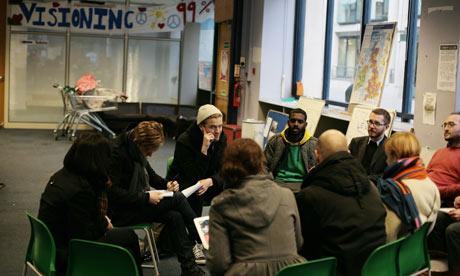
In the University of Ideas, a talk had begun inside one of its classrooms, a vast, chilly office space made as comfortable as possible despite a stained blue carpet and a shopping trolley full of placards in a corner. A newly arrived group of Occupy supporters from Finland, identifiable by their suspiciously pressed-looking clothes, were listening to a man from the New Democracy Foundation thinktank expound on modern protest.
The audience members – arranged in a circle rather than facing him in rows – made their own points.
"It's very interesting, this idea that there's not just one way – a single conduit for information and then you maybe get to ask a few questions," said one of the Finns, Erkki Perälä. "You could call it a more multi-dimensional way of learning, and I think you get a lot more from it."
What's on the syllabus
With a motto of "Anyone can teach, everyone can learn", the Tent City University has a broad curriculum, if understandably biased towards the concerns of protesters against the global finance system. Recent lectures have included:
• The fashion designer Vivienne Westwood on the links between ecological and economic crisis.
• Understanding the Arab uprisings from above and below, by an academic from the University of London's School of Oriental and African Studies.
• Revolution and creativity in the artist William Blake, by author and the poet Jeremy Reed.
• The case against usury (accompanied by ukelele), by Tom Hodgkinson, editor of the Idler.
• How to find social meaning in your dreams, by experts from the Tavistock Institute, a leading centre for psychoanalysis.
• How to start your own credit union.
• Lessons from a football tour of Egypt, Palestine and Jordan.
• Workshops on knitting and clowning.
Clearly, some folks have failed to understand what makes America the greatest place on earth, even with the passel of problems we face as a country today.
Come to think of it, it may very well be that ignorance like this is exactly why we have the problems in this country in the first place...
"We hold these truths to be self-evident, that all men are created equal..." - Thomas Jefferson, July 4, 1776
"Four score and seven years ago our fathers brought forth on this continent a new nation, conceived in liberty and dedicated to the proposition that all men are created equal." - Abraham Lincoln, Nov. 19, 1863
"When was America all about everyone being equal?” - Florida contractor and Gingrich fundraiser Mary Forristall, quoted in the Washington Post on Jan. 28, 2012
There you have it: America's great political debate summarized in three quotes. Forristall is not the first conservative, and definitely won't be the last, to dislike equality. Our history is littered with a surprising number of quotes just like it. Most of us think the ideas of Jefferson and Lincoln and Martin Luther King Jr. firmly planted equality in American soil and made it as apple-pie all-American as you could imagine, but the debate goes on. From Alexander Hamilton to John C. Calhoun to the Social Darwinists of the 1880s to Ayn Rand, William Buckley, and Jesse Helms of the last century and the tea partiers of this, there has been a long line of conservatives who are appalled and terrified by the idea of equality. There are a lot of remarkably blunt quotes on how absurd the idea of equality is from all kinds of conservatives which I featured in my book, "The Progressive Revolution: How the Best of America Came To Be."
When conservatives want to be a little less overt about their disdain for the notion of equality, they will say that, of course they believe in equality of opportunity, they just oppose equality of results. Besides being a ridiculous straw man (no one I have ever met has argued for absolute "equality of results,” or the idea that it isn't fine for people to get rewarded when they build and sell great products), they almost always immediately undercut their own argument by proposing cuts in student grants and loans, public education, Head Start and child health programs that get kids off to a better start in life. They are all for equality, they say, but never want to extend equal protections under the law to new classes of people being discriminated against. They support equality but don’t care if people with illnesses or pre-existing conditions can’t get health care coverage. They are for equal rights under the law but support eliminating funding for legal services, and allowing bankers who commit financial fraud to skate by without ever being investigated. They think equality is wonderful, but are indignant that progressives ask that millionaires and billionaires pay at least as high a tax rate as their secretaries.
Conservatives are on the defensive on equality issues to a degree they haven’t been in at least four decades, and they are flailing around pretty badly trying to defend their patrons in the 1 percent. More straw men are being created than in the Land of Oz. The Washington Post has had two big pieces in their editorial pages the last two days with conservative writers desperately trying to defend wealthy people from having to pay a fair share of taxes.
First up, with the lead editorial on the front page of The Washington Post Sunday Outlook section, was a piece by James Q. Wilson with the monster-sized headline “Don’t Blame the Rich.” The Post’s sub-headline was “Scholar James Q. Wilson argues that taxing the wealthy won’t end poverty.” Straw man number one: I’d be hard pressed to ascertain what progressives were blaming “the rich” for. I, appropriately, blame a lot of the big Wall Street bankers for crashing the economy through financial fraud, forcing the rest of us to bail them out, and then whining because we don’t love them anymore. Likewise, I blame oil and coal companies for polluting the air and threatening the earth with catastrophic climate change. I blame health insurance companies for dropping millions of people out of coverage when they get sick. I blame big business execs who outsource jobs from America so they can pay slave wages in China and Third World countries. But I have nothing against rich people generally.
If you are a manufacturer who has created a great product and employs a lot of people to make it while paying them a decent wage and making sure they have health benefits, and gets rich as a result, I have nothing but love for you. If you are a small business owner that provides amazing service for your community and gets rich as a result, that is tremendous. If you are a community banker who gives small business and home and auto loans to the people in your community, and make great money, God bless you. If you run a website that produces great content with a huge audience, and you reap the rewards, wonderful. I blame entrepreneurs like that for nothing, and am thrilled for their success. But I still want to see them, and everyone with the ability to, pay their fair share of taxes.
Straw man number two: I have never heard anyone say that taxing the wealthy, all by itself, would end poverty. There are many different ways we can attack the poverty problem, and a lot of them do require money, some of it private and some of it public, but poverty is not going to end overnight or be solved by any one policy measure. But what could taxing the wealthy more do? Help reduce the federal deficit, pay for more schools, repair the schools we have in so many places that are falling apart, hire more and better teachers. It could rebuild our roads, highways, sewer systems, bridges, and the rest of our crumbling infrastructure. It could make sure the entire nation has access to high speed broadband internet service, pay for more research and development, invest in more prenatal care, early childhood programs, Head Start, and quality child care. There are many other needs this country has, and taxing the wealthy at a fairer rate would definitely help us pay for all those things. But you know what else? It is also a matter of simple fairness and justice: People with wealth got wealthy in part because of the blessings of this country, and they ought to pay their fair share to support it.
Straw man number three: Progressives want to tax the rich only to help the poor. Now I will admit something here: Being the lefty freak that I am, I do actually care about helping poor people. Although I don’t believe all the theological teachings of my childhood, I do still believe that the Jesus of the Gospels was right when he said we would ultimately be judged on how we treated “the least of these,” and in general those with less than us. And I think it is also just good public policy: When you help lift poor people up, give them opportunities for a better life, you make our country stronger as a whole. But the conservatives’ goal in saying the only point of taxing the rich is to help the poor is to divide poor people from the middle class. The fact is that while the safety net for the poorest among us is tattered and in need of repair, there is very little safety net at all for the middle class. It is the middle class that built this country, and when the gap between us and the wealthiest keeps growing exponentially, the middle class gets crushed. Poor people are in trouble in this country but the middle class is as hard-pressed as it has been since the 1930s.Their wages are stagnant, their homes have crashed in value, and they have groceries, energy, health care, and college tuition costs rising. Their kids’ schools have been falling apart and seeing teacher layoffs, fire and police services keep getting pared back, roads have big potholes that never seem to get fixed and bridges are in danger of collapse because the wealthiest in society aren’t paying their fair share in taxes. This issue of fundamental fairness and vast economic inequality is not just about helping the poor; it really is about helping the entire 99 percent.
Wilson’s opinion piece ignores a wide range of recent research showing social mobility slowing down dramatically in America and being far worse than most industrialized countries, and he is remarkably selective about the data he does use—using statistics more than once that mysteriously only go up to 2006, before the collapse of the last few years, and ignoring data from more recent years that shows how income inequality has gone up in most Western countries, but by far the most here. He makes a special point, of course, in noting that inequality has gone down in Greece, while never mentioning how much stronger than ours the economies have been of several European countries (including Germany, Denmark, and Sweden) who have far better income inequality numbers.
Then there is Robert Samuelson’s piece. He adds a fourth straw man to Wilson’s big three: that passing the Buffett Tax wouldn’t solve the deficit problem. Well, no, Mr. Samuelson, but it would help. No one who supports the Buffett tax has argued that if we just passed that and did nothing else, all our federal deficit problems (or the deficit in public investment for education, infrastructure, and all the rest for that matter) would magically go away. To solve all those problems, you would also need to end the Bush tax cuts for the wealthy, close all the unproductive corporate tax loopholes, end the deduction for million dollar-plus homes, stop subsidizing oil companies and big corporate agribusiness, impose a tax on Wall Street speculation, cut wasteful defense spending, create a robust public option in health care, negotiate with drug companies on Medicare Part D, and reform federal contracting policy. Oh, and start creating economic growth and new jobs at the rate Bill Clinton did in the 1990s. You do all that stuff and the deficit gets solved pretty easily, but I’m guessing a hard-line conservative like Samuelson would oppose almost all of those policies.
Samuelson concludes his article by saying this: “But recognize that the anti-wealthy populist rhetoric is mostly political expediency. It distracts from the serious issues the country faces—creating jobs and closing long term budget deficits. The anti-rich backlash is growing; a Pew poll finds 66 percent of Americans see strong conflicts between rich and poor, up from 47 percent in 2009. Pandering to this is easier than dealing with the future.” Not seeing that the richest 400 families in America have more wealth than the bottom 150 million Americans is a “serious issue” and one of the most tragic flaws of conservatism. This kind of imbalance creates a country that looks far more like the Third World than like America in her mid-20th Century glory years. And you will never create big numbers of jobs or curb long-term deficits without a prosperous and expanding middle class. To suggest that those of us who care about issues of economic equity are pandering, or—another one of my all-time favorite straw men—are envious of the rich—suggests a fundamental lack of understanding about either good economic policy or our nation’s history. I’m not envious of the rich; I’d just like the rest of us not to be crushed by their greed.
The truth that we are all created equal is indeed self-evident. America was in fact conceived in liberty and dedicated to the proposition that all of us are created equal. And if a certain small sector of our economy grows so much richer and more powerful than the rest of us, it strikes at the heart of the America we used to be, and are supposed to be.
Anytime I see a story about someone or some organization who has been able to raise enough private money to establish a housing complex for the chronically homeless, replete with wraparound case management services, I am struck by the lack of Nashville's ability to do the same.
In fact, I find it heartbreaking that in a city priding itself on the belief that we come together in times of trouble cannot come together enough to help establish affordable housing for the hundreds of individuals living on our streets, in our woods, and even in our doghouses.
It's certainly not from a lack of available potential donors or folks who care enough to pitch in to help. We are a city filled with people who understand that some are less fortunate than others, and that but for the Grace of God, there go I. I've never met so many people willing to jump in and help others overcome the very worst the world throws at them.
Interestingly, we are a city built upon the vagaries of music, with artists, established and aspiring, who can speak to the incredible impediments facing those living in hard times. Some of them have spent time themselves struggling on the streets here, and were lucky enough to be able to parlay their love of music into success. Many however continue to struggle just to get by. Surely there are musicians and performers who would come together to help, fund, support, encourage, advocate and construct housing for our city's most vulnerable and disenfranchised.
This is also a city that knows a thing or two about fighting for equality, recognition of basic human rights, and the dignity of an individual, regardless of where they came from, the color of their skin, or the current condition of their life. It's hard for me to believe that these folks are simply wringing their hands or have their heads stuck in the sand as they watch people experiencing homelessness be relegated to "unimportant" status.
The People of Nashville are honest, hardworking and compassionate to a fault. Their faith is unshakable, their determination to overcome challenges that would send lesser men and women screaming into the night unquestionable. They will fight for as long as it takes, if that is what it takes.
They are friendly, willing to endure hardship for the betterment of their community as a whole, and fiercely dedicated to ensuring that everyone in the community gets a fair shake. In no other place I've lived have I ever had so many friends who will drop whatever they are doing at a moment's notice to come help me, or anyone else, for that matter, with little regard for how this will impact their own daily schedules or existence.
So why can't we seem to get our act together enough to create some affordable housing in order to end homelessness in our city?
We even have the political will, which is usually a key barrier in many of these kinds of situations. While we need to understand that government cannot and should not have to do it alone, the Key Alliance is there to help access that political will and ready to go to work for anyone who can step forward to help them get started with a housing project. We've got nationally known and recognized experts in the areas of homelessness and poverty standing by to lend their input, leadership and vision. We're even connected to other national experts by association with individuals who live in Nashville and work with the folks around the country on a daily basis.
The faith-based community, long the primary reason many persons experiencing homelessness in Nashville haven't died of starvation and exposure long ago, are poised and able to pitch in biblical levels of support around ending homelessness. What they do individually on a daily basis for those experiencing homelessness is nothing short of miraculous. Imagine what could be accomplished if we could collectively focus all those resources, dedication and commitment to one united effort to help end homelessness by providing affordable housing and supportive services!
We've got literally dozens of housing models to pick through as well, from John Parvensky's incredible Denver-based spectacular 90+ unit complex that rents its first floor out to local businesses to help defray mortgage costs (and those businesses hire people to work directly from the complex itself. One, Pizza Fusion, actually trains folks to return to work), to Bill Hobson's Seattle DESC Housing First Projects, to Becky Kanis' 100,000 Homes Campaign, to the Los Angeles Project 50 Skid Row effort, and these are just the tip of the housing iceberg.
I simply do not understand the inability for Nashville to come together to accomplish this something like providing housing to its poorest community members.
Frankly, it is antithetical to what I know and love about Nashville.
We are Nashville, and we can do this. There are lives depending on us to make it happen and I cannot, will not, accept that we have failed.
I don't think Nashvillians will accept failure on this issue, either.
Moore Place, an apartment complex to serve the chronically homeless, will house 85 people and have a full-time nurse and part-time physician. ROBERT LAHSER - rlahser@charlotteobserver.com
More than a year ago, William Pumphrey was part of a choir that celebrated the start of construction on an apartment building to serve the chronically homeless.
He didn't realize then that he was looking at his future home.
Early last week, Pumphrey learned he had earned a spot at the Moore Place apartments. Then he saw the second-floor apartment he'll move into early next month.
The news, the 53-year-old said, brought him to his knees.
On Sunday, Pumphrey and the Voices of Love choir were among hundreds of people marking the grand opening of Moore Place, an apartment building for 85 people off North Graham Street.
The $10 million facility was funded primarily with privately raised funds, including gifts from corporate and philanthropic foundations, the Charlotte Housing Authority, more than 50 local congregations and the John and Pat Moore family. The effort was led by Charlotte's Urban Ministry Center. The first eight residents will move in this week, and officials expect the complex to be full by the end of April.
Plans already are under way to add 35 more apartment units on the property, said Caroline Chambre, director of Urban Ministry Center's HousingWorks program.
In recent years, the Urban Ministry has piloted another housing program that offers people who have been homeless a permanent place to stay in sites scattered across Charlotte.
But Moore Place is considered a bigger shift in how the city has addressed the issue of people who are chronically homeless.
Residents will pay 30 percent of their income toward rent. The apartment facility will have on-site case management and 24-hour security.
Moore Place also will offer residents services such as job training, instruction on how to manage their money and counseling. A full-time nurse and part-time physician also will offer health care at the site.
Chambre said the goal is to help residents "go from a life of chaos to a life of normalcy." She described the effort as not being extraordinary; rather, a way to "create the ordinary" in residents' lives.
Pumphrey, who has been homeless on and off for the past 12 years, said Sunday he's not sure he'll ever be able to overcome all of the issues he's faced in recent years.
But he thinks the services provided by Moore Place will be immensely important for him and others.
"I feel taken care of, and I haven't even moved in yet," he said.
Charlotte has an estimated 6,500 people who are homeless. About 10 percent are considered chronic cases, meaning mental illness or addiction prevents them from finding housing through traditional programs such as shelters.
Advocates have said providing housing and other services for the homeless can save millions because it could cut down on those individuals going to "de-facto shelters" in jails or emergency rooms.
Charlotte-Mecklenburg leaders approved a "10-year Plan to End Homelessness" six years ago to create more permanent housing such as Moore Place.
Charlotte Mayor Anthony Foxx on Sunday praised efforts to complete Moore Place, noting challenges such as a fight over where to put the apartments. But he said even more housing facilities are needed.
He urged attendees at the grand opening event to pay attention to upcoming discussions among the City Council about housing bonds and a locational policy on where to put affordable housing.
Foxx said the community needs to find a way to create additional housing.
"We don't just need Moore Place," he said. "We need more places."
Read more here: http://www.charlotteobserver.com/2012/01/30/2970430/facility-creates-ordinary-for.html#storylink=cpy
 As Nashville continues its struggle against lack of affordable housing, outreach specialists and critical services needed to serve the most vulnerable and marginalized in our community, some agencies and advocates stand out from the rest in their tireless effort to bring whatever they can to the table (no pun intended) in order to make life a little easier for those who must endure it homeless.
 Second, the issue of housing, or more specifically the lack thereof, especially for people who present challenges to traditional units, continues as a glaring reality for us as a city. Most of the folks at this particular camp are transplants from the original Tent City, which closed on May 5th, 2010 when flood waters along the Cumberland River did what city officials could not; empty the camp completely and wipe out all standing structures. As the waters receded, police began enforcing the "no trespassing" order with a vengeance, arresting and jailing anyone who dared set up a camp site in the area.