"Cases like this are common across the US and they rarely make the news, outside a small headline in a regional paper." SE SmithIndeed they are, and it's pretty rare to see these outrages, done "under the color of authority," receive the coverage that Kelly Thomas' death has brought to the issue of street engagements with persons experiencing mental health emergencies.
The saddest part of this is of course the death of a man who was in need of serious treatment and received a vicious beating by animals masquerading as police officers. But a close second in sadness is the fact that, as budgets are slashed and burned by politicians who ignore public will and choose instead to balance the country's budget directly upon the backs of - and at the expense of - the poor and the middle class, less and less resources will be available to assist people like Mr. Thomas in their hour of extreme need.
It's no wonder too that police work so hard to restrict the use of video cameras and photography among the citizenry when they are operating in the public sphere. If you were involved in the brutal oppression and blatantly illegal and violent acts you are perpetrating upon those you are sworn to protect and serve, you'd want to suppress any possible evidence that fingers you as an active participant.
Now more than ever, as budgets that provide services for the poor are winnowed to ridiculous levels which render the service to be delivered all but worthless, we must remain vigilant and attentive to the potential for outrageous criminal conduct by law enforcement and other "direct service" providers who are supposed to be acting in the best interests of the individual in need of treatment or assistance. Frustration at the lack of resources doesn't just affect those who receive the resources, it affects those who must now try to find alternatives for that person as well....
This isn't a situation unique to California, either. Scarce resources, overworked staff, overburdened facilities and ever-shrinking funding streams have conspired to make obtaining rapid and worthwhile treatment the exception rather than the norm. This is not to disrespect the often herculean efforts delivered by those who work hard every day delivering the very best service they can with what they're able to scrape together from a fragmented network of often broken and always $-broke service providers.
One has to wonder just how much longer these individuals can be expected to endure before they too join the ranks of the disappointed, disillusioned and increasingly apathetic clients they try to serve each day....
California's hidden mental health crisis
The alleged deadly beating of homeless man Kelly Thomas by police highlights the effects of brutal mental health cuts
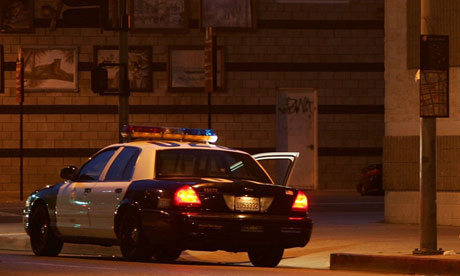
Police on the streets of Los Angeles. Photograph: David Mcnew/Getty Images
On 5 July, police officers in Fullerton, California, responded to a call that a man appeared to be breaking into cars in a bus station parking lot. What could have been a routine call turned into a tragedy when six officers allegedly beat a 37-year-old homeless man with schizophrenia so severely that he fell into a coma. Six days later, Kelly Thomas was taken off life support and died.
This is a story that could easily have fallen through the cracks. Cases like this are common across the US and they rarely make the news, outside a small headline in a regional paper. Approximately one third of the homeless population in the US experiences severe mental illness and many homeless people lack access to mental health services, particularly in California, where a series of brutal cuts to mental health programmeshave gutted county and regional agencies. Many of these cuts have aprofound impact on lower-class populations, who cannot afford to seek care through alternate means. There are many Kelly Thomases in California.
One man, however, decided that Thomas's death should not go unremarked. Tony Bushala, a real estate developer who runs the site Friends for Fullerton's Future, was outraged, and he refused to let up, publicising the story until the mass media picked it up. The explosion of the Thomas case into headlines around the world illustrates the power of citizen journalism.
The facts of the case are difficult to discern; the Fullerton police department has been extremely tightlipped about the case, and refuses to release statements and video from the officers involved, who remain unnamed. Speculation about the case fill in some of the gaps; Friends for Fullerton's Future has revealed the names of the police officers it suspects were involved, for instance.
What is known is that police received a call about break-ins, and found Thomas at the bus stop. They approached him for questioning and he attempted to flee. Witnesses at the scene claim that the police tried to restrain him and when he struggled, they commenced a beating with their flashlights and used Tasers to subdue him. The distinctive clicking noise of a Taser can be heard on videos from the scene, bearing out this claim. "They killed him," witnesses said after seeing Thomas's severely beaten face, which was so badly injured that his father initially thought his son had been attacked with a baseball bat.
Ron Thomas, Kelly's father, is an ex-law enforcement officer who is deeply troubled by the case. He claims that he's been offered $900,000 to settle the matter out of court, and is considering accepting the money to create a fund in honour of his son. Meanwhile, Fullerton has exploded with rage over the alleged police brutality case, a highly unusual occurrence for Orange County.
Orange County is one of the most conservative counties in California. It is strongly Republican and very pro-law enforcement. Yet protesters are showing up on the streets and outside the police station to express their rage about the Thomas case. Citizens demanding justice is clearly an alien experience for the police department, which doesn't know how to respond. It's been criticised for its silence on the case and the officers involved were only recently placed on administrative leave, pending investigation of the matter. The Federal Bureau of Investigation has become involved, another surprising turn of events in a case of this nature.
Some media reports on the story claim that Kelly Thomas was gentle and kind, statements repeated by many people who knew the man, who was a fixture on the streets of Fullerton. Others claim that he was a "problem". Thomas certainly had clashes with police at various points during his life and racked up an assortment of charges related to these incidents; Ron Thomas claims that his son went on and off medication, a common issue for homeless people with mental illness, and may have been agitated and unable to understand commands from police.


