Having spent at least a modicum of time in the DC area over the past couple of years, and heading there again in a couple of weeks, I know that the area around the Capitol literally springs to homelessness life after dark. Folks are scattereed all over the place, eking out an existence in the shadows of the buildings that house the wealthiest, most powerful government in the world.
It's shocking, really, to see this many individuals sleeping on benches, curled up on the steps of churches, wandering aimlessly around the city's center as they try to pass time the best they can.
Meanwhile, around them some of the most influential men and women in the world conduct financial business with dollar amounts so large many of us cannot even begin to comprehend the impact that much money would have in ending homelessness.
Many of those very same people then balk and demand concessions from the poorest of the poor while giving tax breaks and subsidies to companies who, besides making literally billions of dollars in profit each quarter, have taken these huge sums of money and used them to move out of the US in order to hire cheap labor from third world countries.
A Capitol offence: homelessness in DC
Washington's political class prospers, but as budget cuts bite, what it means to be a have-not in the capital is starker than ever

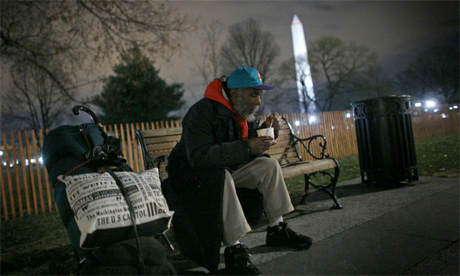
A monument to Reagan's cuts in social welfare programmes: a homeless man in Washington, December 2008. Photograph: Jim Young/Reuters
Whatever Ronald Reagan had in mind for the shining city on the hill, it could not have been Washington. His lasting legacy to the capital city has been to make permanent an encampment of homeless people. There always have been poor here, living in sharp contrast to the well-to-do political world of the city. But the homeless, during DC's recent history, appeared with Reagan's inauguration in 1981. They are testament to the first wave of conservative cuts in social welfare programmes, which, among other things, resulted in Reagan's famed "welfare queens'', along with the supposed malingerers who turned out to be mentally ill, being forced onto the street. Administrations have come and gone but the homeless have become a permanent fixture in the city's life – a reminder that the conservative era launched by Reagan has little in common with Roosevelt's New Deal. There are now some 16,000 people who live on the streets of Washington in any one year, with at least 1,000 families among them. This city of 600,000, which considers itself progressive, young and hip, and where whites have now replaced blacks as a majority of the city's inhabitants, has sought to help homeless people with shelters, social programmes and housing. But there is not enough low-cost housing to make a serious dent. Cont. here


