"Poverty-related concerns impair cognitive capacity. Simply put, being poor taps out one's mental reserves. This could explain data showing that the poor are likelier than others to behave in ways that are harmful to health and impede long-term success—in short, behaviors that can perpetuate a disadvantaged state." ~Kathleen D. VohsOver the past 50 years I've experienced first-hand the benefits of education in lifting me from indigence, helping me overcome an addiction, and making me a more well-rounded, socially conscious, politically astute participant in my community. There is no doubt that an education delivered to me the tools, skills and knowledge needed to escape the chains of poverty and can be considered the "great equalizer" for those saddled with the challenges and barriers brought about by a life lived poor and without resources.
But that education came in fits and starts, and my primary and secondary school experiences were terribly challenging and at times traumatic for several reasons. First, I actually had ADHD (unlike so many kids today whose teachers just want them docile and drooling) and school bored me to tears. In those days, schools and instructors were woefully unequipped to deal with challenging students, especially smart ones. Second, I was constantly changing schools as my parent moved for job demands and by the time I was 14, I'd been in a different school for each year of my education and one year attended 5 different schools. By the time I entered 7th grade, I was using marijuana heavily and my hatred of authority was expanding with every disciplinary action I received at the hands of an utterly clueless education system. It was also at 14 that I decided there was something better for me than school, so I disappeared from the education system and began working with a fake ID.
It wasn't until I entered the job market in 1974 and worked the next ten years that I began to realize the critical importance of education. Like most people who drop out of school, I held a number of both factory and restaurant shit-jobs, endured "supervision" by megalomaniac tyrants whose only qualification that exceeded mine was their high school diploma, and my hatred of authority blossomed. About that time I also became politically aware, thanks to both the Vietnam war and the resignation of President Richard Nixon, and, influenced heavily by my peers from the "Summer of Love" generation, I embraced my counterculture cohorts and tried to survive for the next 20 years in an environment that increasingly tried to exert its authority over us.
That didn't go so well for either of us, which is why I'm in a position today to share the missteps of that journey with others in order to support them as they navigate their way through a life that doesn't come with a very good instruction manual.
Hindsight is 20/20 of course, and education helped me craft the lens that provided the clarity I needed to figure out where I'd gone wrong, and more importantly, how I could get back on track.
It was education that taught me to think critically; control my temper and my ADHD impulsivenesss; and informed me about my addiction and how to control it. Education also provided me an opportunity to earn a real living after toiling in dead end jobs for what seemed like three lifetimes. Education was also the great equalizer for me, helping me overcome publicly recorded errors of judgement done in my ignorance and youth. Granted, this didn't come from primary schooling but instead from college. However, had I been able to receive a quality education from a primary school that was familiar with, and receptive to, the needs of a diverse student population (and especially those who are cognitively impacted by the toll poverty takes on them) it is likely that I would have been spared at least some of the agony my missteps and mistakes brought me.
Both poverty and the work experience on assembly lines and commercial kitchens is a powerful motivator for something better, and I can tell you unequivocally as a "hairnet and name-tag graduate," we "re-entry" students come to class with a commitment to learn that most of our younger classmates cannot understand or compete against. We've struggled against incredible odds, worked 80 hours a week at jobs just to keep a roof over our heads and the lights on, and never achieved anything remotely resembling an "American dream" that we'd been told was within everyone's grasp back in primary school. When we come back to school as grown adults with substantial work histories, one thing I can tell you we all know is that we never want to go back to that existence.
Education also helped me discover and understand Maslow's Hierarchy of Needs, and as I climbed the hierarchical ladder, I began to understand more clearly why the lack of education had such enormous impacts upon not just oneself, but upon the entire community, nation and world.
Today I work closely with a large peer cohort in the behavioral health system who are very much like me and who also work within this cohort to deliver services to those who, for a variety of reasons, are still working on the first couple of steps in the Hierarchy.
This perspective, coupled with a decent education and more lived experience than Carter's got pills, helps me understand how it is that some people can consistently vote against their own best interests time after time, making their lives that much more challenging in the process.
This isn't new news to anyone familiar with the formation of our "representative" democracy. Thomas Jefferson, writing in 1820 to William Jarvis, stated,
"I know no safe depositary of the ultimate powers of the society but the people themselves; and if we think them not enlightened enough to exercise their control with a wholesome discretion, the remedy is not to take it from them, but to inform their discretion by education."
A Smithsonian article, Separate Is Not Equal: Brown v. Board of Education, get's us closer to what I think is happening to us as a country today:
"Americans have long believed that a healthy democracy depends in part on free public education. The nation’s founders stressed that an educated citizenry would better understand their rights and help build a prosperous nation. Beginning in the early 1800s, the federal government and the states encouraged a public school system, largely under local control. For millions of children, the American public school movement opened new opportunities. But millions of others were excluded because of their race or ethnicity. Segregated education was designed to confine these children to a subservient role in society and second-class citizenship."It's the "segregated education" statement in the Smithsonian piece that most alarms me, because we've increasingly starved the public school systems in this country and diverted those dollars a number of other areas, but much has gone to charter schools and....prisons. Both charter schools and prisons have a defacto segregating effect, separating a certain group or class of people from the others, and both place a drain on the available funds for primary public schools.
Perhaps the most insidious part of this decline in education is the impact of the criminal justice system on those who. already harmed from the lack of quality education in schools that barely have enough money to keep the doors open, lose the ability to work, receive an education, or even find housing as a result of that conviction. Steven Hawkins, in his article Education versus Incarceration, tells us that,
"Whether we look back over the last two decades, or just the last two years, education, in particular, has become a casualty of state budget battles. Analysis by the National Association of State Budget Officers shows that elementary and high schools receive 73 percent of their state funding from this discretionary fund; colleges and universities count on the fund for half of their budgets. However, $9 out of every $10 that support imprisonment come from the same pot of money. With tens of billions of dollars in prison spending annually, states are finding that there is simply less discretionary money available to invest in education, especially in these lean economic times."
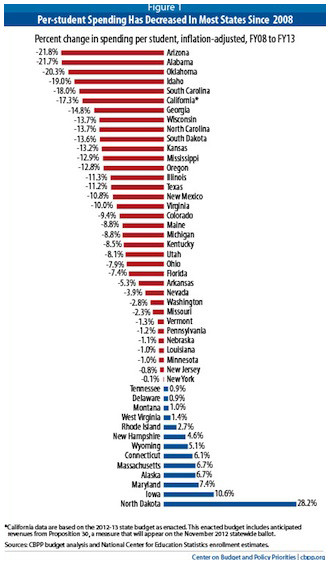
I haven't compared crime rates in states with the largest cuts to public education, and it would certainly be interesting to see if there is a correlation; perhaps that will be the subject of another post.
There's an old saying about data analysis: "junk in, junk out." The more you restrict or limit the opportunity for quality education, the more challenging it becomes for those on the receiving end of substandard or downright lousy education to escape the chains of poverty.
When people are unable to think critically, to examine issues with objectiveness, to be able to set aside judgments and rhetoric, to determine even what a primary source might look like, they are then often also unable to make informed decisions about who will represent them in our political system.
The worse the representation, the more likely it is that very bad decisions are going to be made by those they've chosen to represent them. Obviously, this is a very vicious cycle, with extraordinarily consequences that we're beginning to see manifesting themselves right now...
Study: Poor children are now the majority in American public schools in South, West
The analysis by the Southern Education Foundation, the nation’s oldest education philanthropy, is based on the number of students from preschool through 12th grade who were eligible for the federal free and reduced-price meals program in the 2010-11 school year.
Graphic


Low-income students made up at least half the
public school student population in 17 states in 2011, a marked increase
from 2000, when four states topped 50 percent.
Children from those low-income families dominated classrooms in 13 states in the South and the four Western states with the largest populations in 2011, researchers found. A decade earlier, just four states reported poor children as a majority of the student population in their public schools.
But by 2011, almost half of the nation’s 50 million public-school students — 48 percent — qualified for free or reduced-price meals. In some states, such as Mississippi, that proportion rose as high as 71 percent.
In a large swath of the country, classrooms are filling with children who begin kindergarten already behind their more privileged peers, who lack the support at home to succeed and who are more than likely to drop out of school or never attend college.
“This is incredible,” said Michael A. Rebell, the executive director of the Campaign for Educational Equity at Columbia University, who was struck by the rapid spike in poverty. He said the change helps explain why the United States is lagging in comparison with other countries in international tests.
“When you break down the various test scores, you find the high-income kids, high-achievers are holding their own and more,” Rebell said. “It’s when you start getting down to schools with a majority of low-income kids that you get astoundingly low scores. Our real problem regarding educational outcomes is not the U.S. overall, it’s the growing low-income population.”
Southern states have seen rising numbers of poor students for the past decade, but the trend spread west in 2011, to include rapidly increasing levels of poverty among students in California, Nevada, Oregon and New Mexico.
The 2008 recession, immigration and a high birthrate among low-income families have largely fueled the changes, said Steve Suitts, vice president of the Southern Education Foundation and an author of the study.
Maryland and Virginia were the only Southern states where low-income children did not make up a majority of public-school students. About one-third of students in public schools in Maryland and Virginia qualified for the free and reduced meals program in 2011.
Hank Bounds, the Mississippi commissioner of higher education, said the country needs to figure out how to educate the growing classes of poor students and reverse the trend.
“Lots of folks say we need to change this paradigm, but as a country, we’re not focusing on the issue,” said Bounds, who was previously Mississippi’s state school superintendent. “What we’re doing is not working. We need to get philanthropies, the feds, business leaders, everybody, together and figure this out. We need another Sputnik moment.”
Science
30 August 2013:
Vol. 341 no. 6149 pp. 976-980
DOI: 10.1126/science.1238041
Research Article
Vol. 341 no. 6149 pp. 976-980
DOI: 10.1126/science.1238041
Poverty Impedes Cognitive Function
+ Author Affiliations
- ↵*Corresponding author. E-mail: mullain@fas.harvard.edu (S.M.); shafir@princeton.edu (E.S.)
The poor often behave in less capable
ways, which can further perpetuate poverty. We hypothesize that poverty
directly impedes
cognitive function and present two studies that
test this hypothesis. First, we experimentally induced thoughts about
finances
and found that this reduces cognitive
performance among poor but not in well-off participants. Second, we
examined the cognitive
function of farmers over the planting cycle. We
found that the same farmer shows diminished cognitive performance before
harvest,
when poor, as compared with after harvest, when
rich. This cannot be explained by differences in time available,
nutrition,
or work effort. Nor can it be explained with
stress: Although farmers do show more stress before harvest, that does
not account
for diminished cognitive performance. Instead,
it appears that poverty itself reduces cognitive capacity. We suggest
that
this is because poverty-related concerns consume
mental resources, leaving less for other tasks. These data provide a
previously
unexamined perspective and help explain a
spectrum of behaviors among the poor. We discuss some implications for
poverty policy.
A variety of studies point to a correlation between poverty and counterproductive behavior. The poor use less preventive health
care (1), fail to adhere to drug regimens (2), are tardier and less likely to keep appointments (3, 4), are less productive workers (5), less attentive parents (6), and worse managers of their finances (7–9).
These behaviors are troubling in their own right, but they are
particularly troubling because they can further deepen poverty.
Some explanations of this correlation focus on the
environmental conditions of poverty. Predatory lenders in poor areas,
for
example, may create high-interest-rate borrowing,
and unreliable transportation can cause tardiness and absenteeism. More
generally, poverty may leave less room for error so
that the “same” mistake can lead to worse outcomes (10, 11).
Other explanations focus on the characteristics of the poor themselves.
Lower levels of formal education, for example,
may create misunderstandings about contract terms,
and less parental attention may influence the next generation’s
parenting
style.
We propose a different kind of
explanation, which focuses on the mental processes required by poverty.
The poor must manage
sporadic income, juggle expenses, and make
difficult tradeoffs. Even when not actually making a financial decision,
these
preoccupations can be present and distracting. The
human cognitive system has limited capacity (12–15).
Preoccupations with pressing budgetary concerns leave fewer cognitive
resources available to guide choice and action. Just
as an air traffic controller focusing on a
potential collision course is prone to neglect other planes in the air,
the poor,
when attending to monetary concerns, lose their
capacity to give other problems their full consideration.
This suggests a causal, not merely correlational, relationship between poverty and mental function. We tested this using two
very different but complementary designs (16, 17).
The first is a laboratory study: We induced richer and poorer
participants to think about everyday financial demands. We
hypothesized that for the rich, these
run-of-the-mill financial snags are of little consequence. For the poor,
however, these
demands can trigger persistent and distracting
concerns (18, 19).
The laboratory study is designed to show that similarly sized financial
challenges can have different cognitive impacts
on the poor and the rich. But, the study cannot
fully capture our hypothesis that in the world, the poor face more
challenging
demands. In principle, the cognitive impact in situ
may be different given that the scale of the problems can vary between
the rich and the poor. Perhaps the rich in the
world face larger monetary problems that also cause greater load.
Perhaps the
poor manage to restructure their lives so that they
do not face as many cognitively challenging problems. Put simply, the
laboratory study, although illustrating the
mechanism, does not show its relevance in natural settings.
Our second study takes a different
approach and allows us to assess what happens when income varies
naturally. We conducted
a field study that used quasi-experimental
variation in actual wealth. Indian sugarcane farmers receive income
annually at
harvest time and find it hard to smooth their
consumption (20).
As a result, they experience cycles of poverty—poor before harvest and
richer after. This allows us to compare cognitive
capacity for the same farmer when poor
(pre-harvest) versus richer (post-harvest). Because harvest dates are
distributed arbitrarily
across farmers, we can further control for calendar
effects. In this study, we did not experimentally induce financial
concerns;
we relied on whatever concerns occurred naturally.
We were careful to control for other possible changes, such as nutrition
and work effort. Additionally, we accounted for the
impact of stress. Any effect on cognitive performance then observed
would
thus illustrate a causal relationship between
actual income and cognitive function in situ. As such, the two studies
are highly
complementary. The laboratory study has a great
deal of internal validity and illustrates our proposed mechanism,
whereas
the field study boosts the external validity of the
laboratory study.
We note two observations about these studies. First, they sidestep the discussion on whether poverty is best defined in absolute
or relative terms (21).
Because our hypothesis is about how monetary concerns tax the cognitive
system, we define poverty broadly as the gap between
one’s needs and the resources available to fulfill
them. Because this is based on subjective needs, it encompasses
low-income
individuals both in the developing and the
developed world as well as those experiencing sharp transitory income
shocks, such
as the unemployed. Second, existing theory and data
suggest a possibly cumulative long-term impact of poverty on cognition
(22, 23): Childhood poverty may hinder brain development and eventually reduce adult cognitive capacity (24).
Our hypothesis and tests focus on an immediate impact of poverty on
cognition: Budgetary preoccupations can in real time
impede cognitive function. Our proposed mechanism
does not operate through brain development at early childhood but
through
an immediate cognitive load caused by financial
concerns. Whether this mechanism also contributes to the long-term
impacts
is an open question.
The Laboratory Studies
The first study consisted of four
experiments, with shoppers at a New Jersey mall who participated for pay
(details are available
in the supplementary materials). This sample
encompasses a diverse income range, with the median household income at
roughly
$70,000 and a lower bound of roughly $20,000.
This, broadly speaking, provides a cross-section of the United States,
with
the poor in our sample roughly corresponding to
those in the lower quartile or third of the U.S. income distribution. We
computed
effective income by dividing household income by
the square root of household size (25) and defined “rich” and “poor” through a median split on this variable (26).
In experiment 1, participants (n
= 101) were presented with four hypothetical scenarios a few minutes
apart. Each scenario described a financial problem the
participants might experience. For example:
“Your car is having some trouble and requires $X to be fixed. You can
pay in full,
take a loan, or take a chance and forego the
service at the moment... How would you go about making this decision?”
These
scenarios, by touching on monetary issues, are
meant to trigger thoughts of the participant’s own finances. They are
intended
to bring to the forefront any nascent, easy to
activate, financial concerns.
After viewing each scenario, and while
thinking about how they might go about solving the problem,
participants performed
two computer-based tasks used to measure
cognitive function: Raven’s Progressive Matrices and a spatial
compatibility task.
The Raven’s test involves a sequence of shapes
with one shape missing (27).
Participants must choose which of several alternatives best fits in the
missing space. Raven’s test is a common component
in IQ tests and is used to measure “fluid
intelligence,” the capacity to think logically and solve problems in
novel situations,
independent of acquired knowledge (28, 29).
The spatial incompatibility task requires participants to respond
quickly and often contrary to their initial impulse.
Presented with figures on the screen, they must
press the same side in response to some stimuli but press the opposite
side
in response to others. The speed and accuracy of
response measures cognitive control (30), the ability to guide thought and action in accordance with internal goals (31).
Both are nonverbal tasks, intended to minimize the potential impact of
literacy skills. Upon completion of these tasks,
participants responded to the original scenario
by typing their answers on the computer or speaking to a tape recorder
and
then moved on to the next scenario (an analysis
of participants’ responses to the scenarios is available in table S1).
We
also collected participants’ income information
at the end of the experiment.
Participants were randomly assigned
either to a “hard” condition, in which the scenarios involved costs that
were relatively
high (for example, the car would require $1500
to fix); or to an “easy” condition, where costs were lower (for example,
the
car would require $150 to fix). Because the sums
in the easy condition are small, we expected this condition to evoke
few
of one’s own monetary concerns, for either poor
or rich participants. In contrast, the large sums in the hard condition,
we
hypothesized, would evoke monetary concerns in
the poor but not in the rich participants.
Cognitive performance in experiment 1 is plotted in Fig. 1. For the financially “easy” scenarios, designed to generate relatively trivial concerns, the poor and rich performed similarly
[Raven’s: t(50) = 0.13, P = 0.90; cognitive control: t(50) = 1.55, P = 0.13]. In contrast, in the context of the financially “hard” condition, the poor performed significantly worse than did
the rich on both Raven’s [t(47) = 3.21, P < 0.01] and on cognitive control [t(47) = 5.22, P < 0.001]. A two-way analysis of variance revealed a robust interaction between income and condition [Raven’s: F(1,97) = 5.12, P = 0.03; cognitive control: F(1,97) = 7.86, P < 0.01]. In both tasks, the rich were uninfluenced by condition [Raven’s: t(48) = 0.56, P = .58; cognitive control: t(48) = 1.04, P = 0.30], whereas the poor performed significantly worse in the hard condition [Raven’s: t(49) = 2.63, P = 0.01; cognitive control: t(49) = 3.98, P < 0.001]. As a result, the poor performed reliably worse than the rich performed overall [Raven’s: F(1,97) = 5.61, P = 0.02; cognitive control: F(1,97) = 23.24, p < 0.001]. The magnitudes of the effect here are substantial, with Cohen’s d in this and ensuing replications ranging between 0.88 and 0.94.

Fig. 1
Accuracy on the Raven’s matrices and the cognitive control tasks in the hard and easy conditions, for the poor and the rich
participants in experiment 1.
(Left) Performance on the Raven’s Matrices task. (Right) Performance on the cognitive control task. Error bars reflect ±1 SEM. Top horizontal bars show two-way interaction (poor
versus rich × hard versus easy). *P < 0.05, **P < 0.01, ***P < 0.001
To rule out the effect of “math
anxiety,” experiment 2 used the same set of numbers as in experiment 1
but with nonfinancial
scenarios. This recreates a mathematical problem
but without evoking financial concerns. There was no interaction
between
the difficulty of the scenario and participants’
income (further details are available in supplementary materials,
experiment
2). Thus, the reduced cognitive performance in
the poor participants in experiment 1 was not due to anxiety with large
numbers.
Experiment 3 added incentives to experiment 1: In addition to the standard participation fee, participants earned $0.25 for
every correct response on both tasks. Performance in experiment 3 (n = 100 participants) is summarized in Fig. 2. As before, the poor performed similarly to the rich in the easy condition [Raven’s: t(46) = 0.26, P = 0.79; cognitive control: t(46) = 1.02, P = 0.31] and worse in the hard condition [Ravens: t(50) = 3.34, P < 0.01; cognitive control: t(50) = 3.54, P < 0.001]. The rich performed equally well in the easy and hard conditions [Raven’s: t(45) = 0.07, P = 0.94; cognitive control: t(45) = 1.42, P = 0.16], whereas the poor performed significantly worse in the hard condition [Raven’s: t(51) = 3.75, P < 0.001; cognitive control: t(51) = 3.67, P < 0.001], yielding a robust interaction between income and scenario [Raven’s: F(1,96) = 4.34, P = 0.04; cognitive control: F(1,96) = 4.31, P = 0.04]. Despite the incentives, and the fact that they presumably needed the money more, the poor performed worse overall
[Raven’s: F(1,96) = 6.55, P = 0.01; cognitive control: F(1,96) = 11.88, P < 0.001] and earned 18% ($0.71) less than the rich earned.

Fig. 2
Accuracy on the Raven’s matrices and the cognitive control tasks in the hard and easy conditions, for the poor and the rich
participants, when incentives were provided in experiment 3.
(Left) Performance on Raven’s Matrices task. (Right) Performance on cognitive control task. Error bars reflect ±1 SEM. Top horizontal bars show two-way interaction (poor versus
rich × hard versus easy). *P < 0.05, ***P < 0.001.
The hypothetical scenarios are
intended to trigger participants’ financial concerns. Yet in experiments
1 to 3, the cognitive
tests themselves may have created additional
load because they were performed while the participant was contemplating
the
scenarios. To rule this out, experiment 4 (n
= 96 participants) replicated experiment 1, except that participants
finished responding to each scenario before proceeding
to the Raven’s and cognitive control tasks. That
is, participants viewed each scenario as in experiment 1, responded to
the
scenario, and only then completed the Raven’s
and cognitive control tasks. Because there were no intervening tasks
between
scenario presentation and response, we added a
few scenario-relevant questions in order to equate the time spent with
that
of experiment 1. Performance is summarized in Fig. 3.

Fig. 3
Accuracy on the Raven’s matrices and the cognitive control tasks in the hard and easy conditions, for the poor and the rich
participants in experiment 4.
(Left) Performance on Raven’s Matrices task. (Right) Performance on cognitive control task. Error bars reflect ±1 SEM. Top horizontal bars show two-way interaction (poor versus
rich × hard versus easy). *P < 0.05, **P < 0.01, ***P < 0.001.
The results match those in experiments 1 and 3. As before, there was a robust interaction between income and condition [Raven’s:
F(1,92) = 4.04, P = 0.04; cognitive control: F(1,92) = 6.66, P = 0.01]; the rich and poor performed similarly in the easy condition [Raven’s: t(48) = 0.41, P = 0.69; cognitive control: t(48) = 0.43, P = 0.67], and the poor performed significantly worse than the rich performed in the hard condition [Ravens: t(44) = 3.55, P < 0.001; cognitive control: t(44) = 3.34, p = .002]. Condition was insignificant for the rich [Raven’s: t(47) = 0.08, P = 0.93; cognitive control: t(47) = 0.72, P = 0.47], but significant for the poor [Raven’s: t(45) = 3.26, P = 0.002; cognitive control: t(59) = 3.94, P < 0.001]. Again, the poor performed worse than the rich performed overall [Raven’s: F(1,92) = 6.42, P = 0.01; cognitive control: F(1,92) = 8.74, P = 0.004].
Although remarkably consistent, these
findings have limitations. The causal attribution made possible by
laboratory studies
comes at the expense of some external validity.
For example, in experiment 4 the hypothetical scenarios themselves—even
after
answers were given—may still have weighed on
people’s minds. More generally, in all the experiments we explicitly
primed monetary
concerns. Such explicit priming may not mirror
naturally occurring circumstances. It is possible that environments in
which
one is richer bring to mind other concerns (such
as bigger purchases), creating load comparable with that experienced by
the
poor. It is also possible—though less
plausible—that the poor structure their lives to avoid these concerns.
To address these
issues, we conducted the field study.
The Field Studies
Our second study examined 464
sugarcane farmers living in 54 villages in the sugarcane-growing areas
around the districts
of Villupuram and Tiruvannamalai in Tamil Nadu,
India. These were a random sample of small farmers (with land plots of
between
1.5 and 3 acres) who earned at least 60% of
their income from sugarcane and were interviewed twice—before and after
harvest—over
a 4-month period in 2010. There were occasional
nonresponses, but all of our pre-post comparisons include only farmers
we
surveyed twice.
A challenge with pre-post comparisons
is calendar effects: Differences between months (such as a festival or
the weather)
can create a spurious correlation. We overcame
this through a particular feature of this context: Farmers’ harvest (and
planting)
dates are staggered over a 3- to 5-month period
being set by sugar mills with processing capacity constraints. One
farmer
may harvest, for example, in June, whereas
another harvests in August. The same month then is pre-harvest for some
farmers
and post-harvest for others. This feature allows
us to control for calendar effects.
Our data show that farmers indeed faced greater financial pressures pre- as compared with post-harvest: They pawned items
at a higher rate (78 versus 4%, P < 0.001, n = 462 participants) and were more likely to have loans (99 versus 13%, P < 0.001, n
= 461 participants). On average, farmers had 1.97 more loans before
harvest than they did after it. They were also more likely
to answer “Yes” to the question, “Did you have
trouble coping with ordinary bills in the last fifteen days?” (before
harvest
than after (1.62 and 1.76, respectively, on a
3-point scale, where 1 corresponded to low ability and 3 to high ability
to
cope; P < 0.001, n = 462 participants). (Regressions adjusted to take out farmer and month fixed effects are shown in Table 1, panel A.)
View this table:
Table 1
Changes in financial situation and cognitive capacity around harvest.
This table
presents changes in farmers’ financial situation (panel A) and their
cognitive capacity (panel B) before and after
harvest. Each coefficient reported here is
the result of an ordinary least-squares regression for the dependent
variable in
the row heading. For instance, row 1 in
column 1 shows that on average, a farmer is 56.6% less likely to have
pawned his belongings
in the 15-day interval before the
post-harvest survey than in the same time interval before the
pre-harvest survey. These
coefficients also account for any
differences that may be attributed to the specific months in which tests
were taken. Column
1 reports results for the entire sample;
column 2 reports results for farmers who had already completed the
harvesting process,
but had not yet been paid for the harvest,
at the time of the first-round survey. Each cell is the coefficient γ
from a separate
regression of the type yit = αi + βt + γPostHarvestit, where the dependent variable varies in each row. Here, i denotes individuals, t denotes time, y
denotes various outcome variables, and PostHarvest is a dummy for
whether the observation occurs after harvest. The variables
α and β reflect a set of individual and
time fixed effects, respectively, controlling for all fixed differences
between time
periods (months) and individuals. Robust
standard errors are in square brackets. *Significant at 10%;
**significant at 5%;
***significant at 1%. Main independent
variable = 1 for the post-harvest period and 0 pre-harvest.
We again used Raven’s to gauge fluid
intelligence. For cognitive control, we could not administer the spatial
incompatibility
task in the field. Instead, we used a numeric
version of the traditional Stroop task, which is appropriate for
participants
with low literacy rates. In a typical trial,
participants would see “5 5 5” and have to quickly respond “3,” which is
the
number of 5s in the sequence, rather than “5”
that comes to mind most naturally. Both response speed and error rates
were
recorded. Each participant performed 75 trials
on the numerical Stroop.
Pre- and post-harvest differences on both tests were pronounced and are illustrated in Fig. 4. On Raven’s, the farmers scored an average of 5.45 items correct post-harvest but only 4.35 items correct pre-harvest (P < 0.001, n = 460 participants). On Stroop, they took an average of 131 s to respond to all items post-harvest, as compared with 146
s pre-harvest (P < .001, n = 452). In addition, the average number of errors the farmers committed was higher before harvest than after (5.93 versus
5.16 errors; P < .001, n = 453).

Fig. 4
Accuracy on the Raven’s matrices and the cognitive control tasks for pre-harvest and post-harvest farmers in the field study.
(Left) Performance on Raven’s matrices task. (Middle and Right) Stroop task (measuring cognitive control) response times (RT) and error rates, respectively; error bars reflect ±1 SEM.
Top horizontal bars show test for main effect of pre- versus post-harvest (***P < 0.001).
We also report results of regressions that control for farmer and month fixed effects (Table 1, panel B). Each cell in Table 1 is a distinct regression. Table 1,
column 1 shows that even after regression adjustment, strong pre-post
harvest differences remain for both Raven’s and Stroop
performance. In addition to these pre-post
differences, we found that farmers’ perceived intensity of how
financially constrained
they are—as captured by how they rate their
ability to cope with ordinary bills in the preceding 15-day
period—correlates
negatively with performance on Raven’s and time
taken on Stroop tests (table S2).
Other factors besides income that vary
pre- and post-harvest could drive these effects. One major candidate is
physical exertion;
preparing the land for harvest might involve
increased physical labor. Another candidate is anxiety over crop yield;
farmers
might be preoccupied not with making ends meet
but with how much they will earn. In practice, neither is likely to be
true
in the case of sugarcane farming. Farmers
typically use external labor on their lands, and sugarcane crop size can
be readily
estimated months before harvest. Still, to
address this further we observe that there is a several-week delay
between physical
harvest and the actual receipt of payment.
Financial burdens are only relieved at the time of payment, but labor
and anxiety
over crop size are fully resolved at the time of
harvest. For 316 farmers in our sample, the “pre-harvest” survey was
actually
post–physical harvest but pre-payment. We
reestimated our equation on this subsample as shown in Table 1, column 2, and found highly similar results, which suggests that neither physical exertion nor anxiety pre-harvest drives
our results.
Training effects present another
potential confound; post-harvest farmers may do better simply because
they are taking the
test a second time. To address this, we held
back 100 randomly selected farmers at the time of initial sampling.
These farmers
were surveyed for the first time post-harvest,
and their scores were compared with the post-harvest scores of the
original
sample. If our results were due to learning, we
would expect these novice farmers to do worse. Instead, we found that
they
performed similarly on Raven’s accuracy and
Stroop reaction time (table S3), suggesting no training effect. There is
some
evidence for training effects on Stroop error
rates (table S3), but the overall pattern cannot be attributed to simple
test
familiarity. Taken together, the two sets of
studies—in the New Jersey mall and the Indian fields—illustrate how
challenging
financial conditions, which are endemic to
poverty, can result in diminished cognitive capacity.
We have argued that the attentional demands created by poverty are a plausible mechanism (29).
But there could be other mediating factors. Nutrition is one
candidate—in the harvest findings, if not in the mall study;
farmers may eat less when poor. In 2009, we ran a
pilot study with the same design in the districts of Thanjavur,
Thiruvarur,
Perambalur, and Pudokottai in Tamil Nadu, in
which we surveyed 188 farmers and also asked about food consumption. We
found
similar effects on Stroop (1.47 errors
post-harvest versus 2.12 errors pre-harvest; P = 0.006 via t test, n
= 111 participants). Pre-harvest farmers were not eating less; they
spent 2663 rupees a month on food pre-harvest and 2592
rupees post-harvest (roughly $53 and $52,
respectively, not accounting for purchasing power parity). Additionally,
the Stroop
results persist even in regressions in which
food consumption is included as a control variable.
A potential explanation of these
findings is stress. Financial concerns could reasonably induce stress in
pre-harvest farmers.
Indeed, we examined biological stress. In the
2009 study, we collected two biomarkers of stress: heart rate and blood
pressure.
Both measures showed that the farmers were more
stressed before the harvest; heart rate was higher pre-harvest than
post-harvest
(78.42 versus 76.38; P = 0.088 via t test, n = 188 participants), and so were diastolic blood pressure (78.70 versus 74.26, P < 0.001 via t test, n = 188) and systolic blood pressure (128.64 versus 121.56, P < 0.001 via t test, n = 188).
However, these differences in stress
do not explain our findings. When we reestimated the impact of harvest
on Stroop performance,
controlling for all three stress measures, the
findings remained significant. In fact, the coefficient on post-harvest
did
not change [for Stroop, we continued to find a
coefficient of –1.46 (0.52) on the post-harvest dummy, with a t of –2.80 and P < 0.006; n
= 222 participants]. This suggests that although the pre-harvest
farmers did experience stress, stress cannot fully explain
the impairment in cognitive function. Our
suggested mechanism—that poverty captures attention, triggers intrusive
thoughts,
and reduces cognitive resources—could itself be
described colloquially as “stress”: persistent mental engagement induced
by
some trigger. The 2009 data, however, suggest
that the biological view of stress—as proxied by these biomarkers of
stress—is
not sufficient to account for our findings. This
is consistent with the existing literature on the effects of stress on
cognitive
function, in which both facilitation and
impairment have been found (32). For example, there is evidence that stress can increase working memory capacity (33).
We find attentional capture to be the most compelling explanatory mechanism. It matches findings on the effects of scarcity
on borrowing (34) and is consistent with demand and distraction observed in domains of scarcity other than poverty—from insufficient time
to limited calorie budgets (35). But surely, other mechanisms might be operating. For example, poverty might influence cognitive load by changing people’s
affective state (36, 37). We hope future work will test other mechanisms for explaining these findings.
New Perspectives on Policy
The data reported here suggest a
different perspective on poverty: Being poor means coping not just with a
shortfall of money,
but also with a concurrent shortfall of
cognitive resources. The poor, in this view, are less capable not
because of inherent
traits, but because the very context of poverty
imposes load and impedes cognitive capacity. The findings, in other
words,
are not about poor people, but about any people
who find themselves poor.
How large are these effects? Sleep researchers have examined the cognitive impact (on Raven’s) of losing a full night of sleep
through experimental manipulations (38).
In standard deviation terms, the laboratory study findings are of the
same size, and the field findings are three quarters
that size. Put simply, evoking financial
concerns has a cognitive impact comparable with losing a full night of
sleep. In
addition, similar effect sizes have been
observed in the performance on Raven’s matrices of chronic alcoholics
versus normal
adults (39) and of 60- versus 45-year-olds (40).
By way of calibration, according to a common approximation used by
intelligence researchers, with a mean of 100 and a standard
deviation of 15 the effects we observed
correspond to ~13 IQ points. These sizable magnitudes suggest the
cognitive impact
of poverty could have large real consequences.
This perspective has important policy
implications. First, policy-makers should beware of imposing cognitive
taxes on the
poor just as they avoid monetary taxes on the
poor. Filling out long forms, preparing for a lengthy interview,
deciphering
new rules, or responding to complex incentives
all consume cognitive resources. Policy-makers rarely recognize these
cognitive
taxes; yet, our results suggest that they should
focus on reducing them (11). Simple interventions (41) such as smart defaults (42), help filling forms out (43), planning prompts (44), or even reminders (45)
may be particularly helpful to the poor. Policy-makers should further
recognize and respond to natural variation in the
same person’s cognitive capacity. Many programs
that impose cognitive demand on farmers, for example, from HIV education
to
agricultural extension services (which provide
farmers with information about new seeds, pesticides, and agricultural
practices)
should be carefully timed. At the very least, as
our results suggest, they should be synchronized with the harvest
cycle,
with greater cognitive capacity available
post-harvest. One recent study illustrated this with fertilizer. Farmers
made higher-return
investments when the decision was made right
after harvest as compared with later in the season (46). The data suggest a rarely considered benefit to policies that reduce economic volatility: They are not merely contributing
to economic stability—they are actually enabling greater cognitive resources.
Supplementary Materials
Materials and Methods
Figs. S1 and S2
Tables S1 to S3
References and Notes
- Received for publication 19 March 2013.
- Accepted for publication 23 July 2013.
References and Notes
- ↵
- ↵
- ↵
- ↵
- ↵
- ↵
- ↵
-
- ↵
- ↵
- ↵
- ↵
- ↵
- ↵
- ↵
- ↵ This design resembles “stereotype threat” studies, in which identity-relevant primes diminish cognitive performance (19).
- ↵
- ↵
- ↵
- ↵
- ↵
- ↵
- ↵
- ↵ Alternative measures, such as dividing household income by number of people in the household, yield similar findings.
- ↵
- ↵
- ↵
- ↵
- ↵
- ↵
- ↵
- ↵
- ↵
- ↵
- ↵
- ↵
- ↵
- ↵
- ↵
- ↵
- ↵
- ↵
- ↵
- ↵
-
Acknowledgments: Authors’ names are listed alphabetically; the authors contributed equally to this work. The authors gratefully acknowledge support from the National Science Foundation (award SES-0933497), the John Simon Guggenheim Memorial Foundation, the International Finance Corporation, and the Institute for Financial Management and Research Trust. S. Krishnan, D. Mackenzie, and especially D. Bulla provided able research assistance. The authors declare no conflict of interest.
Science
30 August 2013:
Vol. 341 no. 6149 pp. 969-970
DOI: 10.1126/science.1244172
Perspective PsychologyVol. 341 no. 6149 pp. 969-970
DOI: 10.1126/science.1244172
The Poor's Poor Mental Power
Few people wish to be poor. Many find it puzzling that those in poverty seem to get stuck in that state, even when there are
opportunities to improve one's lot. On page 976 of this issue, Mani et al. (1)
provide a possible reason: Poverty-related concerns impair cognitive
capacity. Simply put, being poor taps out one's mental
reserves. This could explain data showing that the
poor are likelier than others to behave in ways that are harmful to
health
and impede long-term success—in short, behaviors
that can perpetuate a disadvantaged state.
The eye-opening study of Mani et al.
included laboratory experiments and field studies that tested the
“cognitive constraint” hypothesis. One experiment gave
individuals who were poor (defined by household
income) hypothetical financial decisions, followed by tasks that
measured
mental abilities. Poor people who earlier had
contemplated a difficult financial decision showed worse mental
performance
than others. A study of farmers demonstrated that
the mental acuities of the same person varied with swings in income.
Farmers
were given challenging cognitive tests before and
after harvest. Before harvest, the farmers experienced much financial
strain,
whereas after harvest (and the receipt of
payments), they did not. The results showed clear and demonstrable
improvement in
cognitive capacity after harvest. This outcome held
after accounting for the stress of pre-harvest periods. The authors
propose
that poverty imposes a cognitive load, which
impairs cognitive capacity.
The depletion of mental functioning with poverty comports with a framework called the limited-resource model of self-control.
Failures of self-control are implicated in some of society's most pressing problems, including poverty (1–6).
When people want to reach a goal, they use self-control to produce
responses and behaviors aimed at moving themselves from
the current (undesirable) standpoint to the
preferred state. This powerful process, however, is not used as often as
it should
be. One reason is that self-control is a limited
and depletable resource (7). When people use self-control, it is like top-flight running for a cheetah, in which a brief period of exertion results
in exhaustion.

Mental toll.
People become
progressively worse at self-control the more they have engaged in
self-control previously. The more that people
used self-control not to give into desires
earlier in the day, the more likely it was that a desire impelled an
impulsive
behavior later in the day. This situation is
akin to poverty, which requires that people often battle back desires.
Adapted
from (12).
CREDIT: H. MACDONALD/SCIENCE
Everyone must regulate eating and
spending, and wearing down self-control resources leads to detrimental
behaviors for both.
In one study, people made to resist the lure of
delicious chocolates later showed worse performance on demanding mental
tasks
and at managing negative emotions. Moreover, it led
to overeating unhealthy foods (8).
In another situation, participants were given cash to spend or keep.
Those who earlier had used self-control to suppress
unwanted thoughts later spent more money and
reported stronger desires to spend all the newfound cash. The depletion
of self-control
ability led to unwise spending (9).
Both examples suggest a vicious cycle: Overcoming urges and making
decisions can deplete mental resources, which in turn
can lead to problematic behaviors. Because the poor
must overcome more urges and make difficult decisions more often than
others, they are more likely to overeat, overspend,
and enact other problematic behaviors.
Self-control may be the greatest human strength (6)
because it is involved in the ability to make wise choices. Several
studies have found that after using self-control (and
thus reducing the resource), decision-making
patterns shift toward favoring intuitive over reasoned options (10).
For example, options were constructed so that they were extreme on some
dimensions (e.g., expensive and high quality) or
balanced (moderate price and modest quality).
Choosing the latter reflects the use of deliberate cognitive strategies
to accept
trade-offs. Those who earlier had engaged in
self-control activities preferred extreme options that required fewer
trade-offs.
Moreover, the process of making trade-offs itself
requires self-control (11). These findings suggest that decisions requiring many trade-offs, which are common in poverty, render subsequent decisions
prone to favoring impulsive, intuitive, and often regrettable options.
Regulating urges and desires, even basic
ones such as for sleep and leisure, exacts a cumulative effect.
Researchers surveyed
people seven times a day for several days, tracking
their recent desires, attempts at resistance, and whether they
performed
behaviors implied by the desires. In line with the
limited-resource model, people became progressively worse at
self-control
the more they resisted unwanted desires (12) (see the figure).
Chronic pain may be analogous to poverty (13) as these patients' behaviors parallel those seen by Mani et al.
Patients with fibromyalgia, a chronic pain disorder, performed a task
that either did or did not require focused attention
(comparable to the focus required to drive during
pummeling rain, for example). Afterward, they were given a challenging
cognitive
task. The outcomes were striking. Patients with
chronic pain had poor cognitive performance regardless of whether they
earlier
had used self-control or not. By contrast, healthy
individuals showed the standard depletion effect of worse performance
only
after previous exertion of self-control. These
findings imply that there may be entire segments of people who, like the
poor
and those chronically in pain, suffer constant
self-control depletion.
The limited-resource model of
self-control points to the following state of affairs for people in
poverty. Resisting urges
and controlling one's behavior drains self-control
resources. The poor must resist and control more than others because
they
have less money, food, and expendable time. Such
limited supplies demand trade-offs, and hence many decisions. And, there
is a snowballing, adverse effect of engaging in
self-control on subsequent self-control capacity. Altogether, these
processes
spell a dwindling supply of self-control with few
chances to recover.
Governments and organizations must
recognize that the lives of the poor are filled with land mines of
desire, trade-offs,
and self-control dilemmas. Paring down the sheer
volume of decisions that the poor must make—perhaps through defaults—and
allowing others to share in the decision-making
process could help. Scheduling interviews and appointments earlier in
the
day could be beneficial because people generally
possess greater cognitive capacity at that time (12).
Public settings that require individuals to handle forms, rules, and
decisions could have a care area for children to minimize
competing demands on attention.
Recent estimates show that about 20% of the world's population is in poverty (14). Although that is half of what it was 20 years ago, it is nonetheless a huge number (14).
Economists are fond of the theory that the more people on Earth, the
better, because people create ideas. With more people
come greater odds of discovering the cure for
cancer, renewable energy sources, or how to cultivate world peace. That
premise
rests on the notion that all people have adequate
mental capacity, a premise now called into question by Mani et al. for a fifth of the world's population.


