Upon hearing this, I asked the man why he allowed them into his unit without a warrant? He stated that "the lease has something in it that allows them to do this."
I searched our local Affordable Housing provider for a sample lease and found the following at http://www.nashville-mdha.org/pdfs/ModelLease.pdf Nowhere in this lease did I find anything that overruled a Constitutional Right.
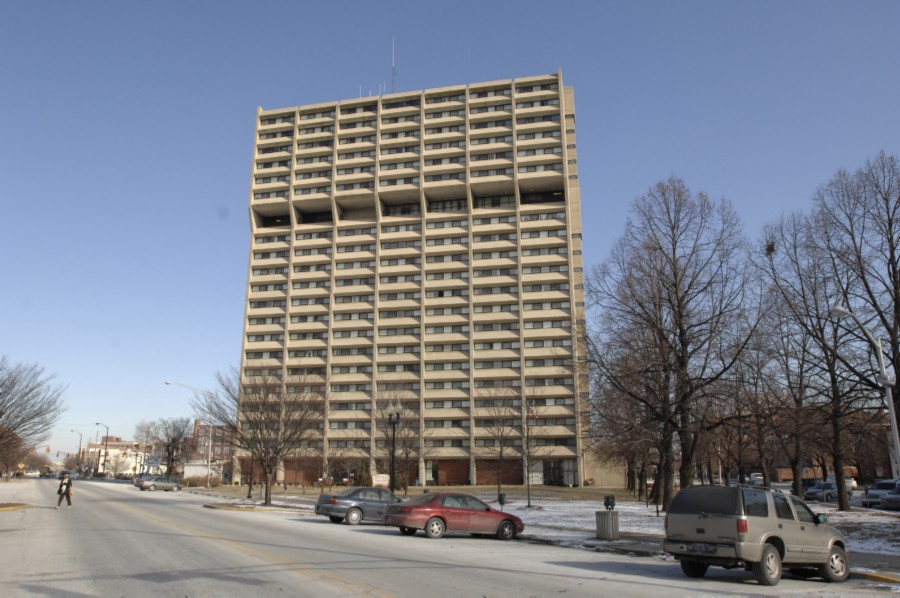 |
| Image courtesy of: http://www.ibj.com/renewal-planned-for-towers/PARAMS/post/1640 |
What I believe may be happening, if what I've been told turns out to be true ( I want to make it clear this is an allegation at this point), is that the landlord may be using an extraordinarily broad interpretation to the following lease condition:
12.Inspection By LandlordIt is understood and agreed that Landlord shall have the right to enter and inspect premises at all reasonable times to insure maintenance and safety of the premises.
As my friend said, he feels like he's living in a prison cell, where guards have the ability to enter and shake him (and every one of his neighbors) down "at will."
If his allegation turns out to be true, I would agree completely with him. I would hope too that even the most passionate hardliner against drugs and criminal activity would pause a moment and consider the ramifications...the slippery slope a policy like this brings to the table for all of us.
Then I would reach immediately out to the ACLU and find a good attorney.
I get that public housing has had its share of serious crime and drug problems, and law abiding residents should not have to live in fear of gangs, dope dealers and the "criminal element." To that end, rigorous enforcement of existing laws, good lighting and security cameras on the property, careful scrutiny and pre-screening or renters, etc., are all effective tools that can significantly reduce the problems associated with drugs and crime. Cities all over the country have used these tactics with great effectiveness, and have done so without trampling - hell, stomping - Constitutional Rights in the process.
But I think a very serious line is crossed when residents with few options for alternate housing are coerced into believing that as a condition of their renting of an affordable housing unit they must open the door on demand and be subjected to police searches without any probable cause and/or a warrant.
Again, I want to point out that at present, I only have one side of the story and I do not have all the facts on the situation, and I may never get them all. But if there is any truth whatsoever to the allegation made by a resident that he did indeed endure this situation, it is a very serious issue that should not be taken lightly by any of us.
Editorial
Public Housing as a ‘Penal Colony’
By THE EDITORIAL BOARD
Published: April 2, 2013
New York City’s constitutionally suspect stop-and-frisk program is rightly being hammered in federal courts. Earlier this year, the court ruled in the case of Ligon v. City of New York that the city had violated Fourth Amendment protections against unreasonable search and seizure by illegally stopping people outside of private buildings in the Bronx. In the case of Floyd v. City of New York, which is currently being heard in Federal District Court in Manhattan, the plaintiffs charge the city with illegally stopping and frisking citizens based on race.
A third lawsuit, Davis v. City of New York, challenges the legality of
the program in the city’s public housing projects, where residents and
visitors say they were illegally stopped or arrested. In a ruling in the
Davis case just last week, Judge Shira Scheindlin rejected most of the
city’s challenges to the plaintiff’s claims, clearing the way for the
case to proceed to trial.
In allowing the case to go forward, the judge noted that jurors might
reasonably reach several troubling conclusions about the case. They
could decide that the police had adopted unconstitutional policies
leading to widespread stops and arrests for trespassing; that the
practice resulted from “inadequate training and supervision regarding
constitutional standards, and inadequate discipline in responses to
violation of those standards”; that the police treat similar crime
levels more aggressively when they occur in public housing developments
that have a large proportion of African-Americans.
Judge Scheindlin agreed that it was necessary to provide security for
public housing developments. But the police’s aggressive stop-and-frisk
tactics, she suggested, had taken an emotional toll on many innocent
tenants.
She cited the testimony of Reginald Bowman, the president of a public
housing resident leadership group, who compared life in the public
housing projects under stop-and-frisk to a “penal colony” where
law-abiding parents are set upon by the police while going to the store
to get milk and cookies for their children.
Instead of belittling the claims of the plaintiffs, the city needs to
settle these suits and ensure that police policies adhere to Fourth
Amendment guarantees of freedom from unreasonable search and seizure.


