
- There are still thousands of vets in-theater and it'll be at least two years from the time they return before we have any sense of how they are faring after they are home.
- PIT & HMIS data is still flawed due to the overall difficulty in accurately counting people experiencing homelessness under real world conditions and the incomplete implementation of the Homeless Management Information System. Frankly, while the data is certainly improving, it is still unreliable for much more than broad generalities. Additionally, this story is using the 2011 data which arrived before the "count" caught up to the massive spikes in homelessness again (remember this announcement by the NAEH regarding the ahar report?)
- Gen. Shinseki, HHS,VA, and HUD have all contributed massive amounts of cash (in one way or another) to address this and a lot of eyes are watching its progress. This a very "high-visibility" effort and there are a lot of competing agendas, interests and ideologies at work behind the scenes on both sides.
I have to add one more point about the general effort of addressing veteran need that has been nagging me for some time now. It's a controversial one and I imagine it will raise a few hackles on some folks, but I've never been one to candy coat the hard issues, so here's the deal.
Studies have shown repeatedly that many who enlist in the Armed Forces come from poor, working and middle class families. Often the Service is seen as a way out of a bleak future and provides an avenue for success that the individual may not ever have under their current conditions. This is a great perk to serving, without a doubt, and I believe they earn every single perk that comes from serving. In fact, when working with vets, who are often very put off by the idea of receiving a "handout," I usually frame any benefit they are entitled to as something they've earned as a result of signing up to put themselves in harm's way, even if they did not see combat. The mere fact that they would have, if called upon to do so, stepped into a live fire scenario is enough to me to say they've earned every damned benefit we can give them.
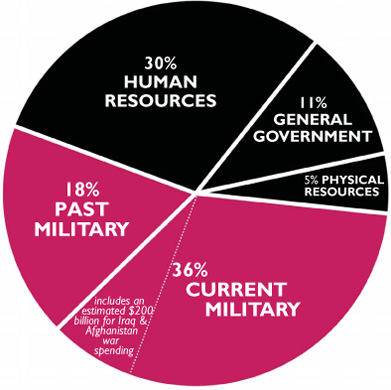 |
| (Image courtesy of: http://www.warresisters.org/pages/piechart.htm) |
If serving in the military is the "best option" for those who are trying to advance their career or lot in life, and if we continually provide "preferential" treatment to veterans who have served, it doesn't take a genius to realize that the Armed Forces will expand. The larger it becomes, the more resources it consumes, which leaves less for the civilian population. One look at a Federal Budget pie chart helps a person understand and compare just how much money is already allocated to "defense" of the country. The problem here is that as money for civilian options dwindle further in order to feed the military budget, more people will choose military service and its related education, housing and healthcare perks over everything else, causing the cycle to continue.
 Please don't misconstrue my point here to mean we shouldn't be supporting our troops and providing them with benefits. Nothing could be further from the truth and those who know me know I've been not only an outspoken advocate of providing veterans with the benefits they've earned but also have worked tirelessly to raise awareness within civilian agencies to help them find better ways of serving veterans who access their services. But at the same time, we need to realize that when we further reduce alternate options for people looking to improve the quality of their lives through education and employment, we also reduce potential paths they can travel to achieve a full and satisfying life. All possibilities should be on the table and accessible for folks, and we should be very careful about the unintended consequences that can arise when we begin to emphasize too heavily one option - either overtly or through the reduction and/or elimination of alternatives- above all others.
 VA-HUD: Homelessness among Veterans Declines 12% in 2011
December 13, 2011 Obama Administration on Track to End Veteran Homelessness by 2015,
Announces $100 Million to Expand Homeless Prevention Program
WASHINGTON – The Departments of Veterans Affairs and Housing and Urban Development today announced that a new national report shows that homelessness among Veterans has been reduced by nearly 12 percent between January 2010 and January 2011. The 12 percent decline keeps the Obama Administration on track to meet the goal of ending Veteran homelessness in 2015. “This new report is good news for the tens of thousands of Veterans we have helped find a home. Our progress in the fight against homelessness has been significant, but our work is not complete until no Veteran has to sleep on the street,” said Secretary of Veterans Affairs Eric K. Shinseki. “We have been successful in achieving this milestone due to strong leadership from the President and hard work by countless community organizations and our federal, state, and local partners who are committed to helping Veterans and their families get back on their feet.”
HUD Secretary Shaun Donovan added, “We’re absolutely headed in the right direction as we work to end homelessness amongst those who have served our nation. This significant decline tells us that the Obama Administration is on the right path, working together across agencies to target Federal resources to produce a sharp and measureable reduction in Veteran homelessness. As we put forth in the first Federal plan to prevent and end homelessness, there’s plenty of work ahead to reach our goal, but these numbers validate the work done by both HUD and VA to reach our nation’s homeless Veterans and get them into permanent housing.”
According to the 2011 supplement to the Annual Homeless Assessment Report (AHAR) released today, 67,495 Veterans were homeless in the United States on a single night in January 2011 -- a significant reduction from last year’s single night count of 76,329.
Since 2009, working with over 4,000 community agencies, VA and HUD have successfully housed a total of 33,597 Veterans in permanent, supportive housing with dedicated case managers and access to high-quality VA health care. The complete 2011 Annual Homeless Assessment Report will be available in 2012.
VA also announced it will make $100 million in grants available to community agencies across the country to prevent nearly 42,000 Veterans and their families from falling into homelessness or to quickly return them to stable housing. The funds are offered for fiscal year 2012 through VA’s Supportive Services for Veteran Families (SSVF) program, a homeless-prevention and rapid re-housing program.
“The problems that lead to homelessness begin long before Veterans and their families are on the streets,” said Secretary of Veterans Affairs Eric K. Shinseki. “By putting more resources into prevention services for those at risk of becoming homeless, we will continue to help more Veterans and their families turn their lives around.”
Last year, VA provided $60 million through the SSVF program to community providers, which will affect nearly 22,000 people through 85 non-profit community agencies in 40 states and the District of Columbia. The program provides community organizations with funding for counseling, training, education assistance, direct time-limited financial assistance, transportation, child care, rent, utilities, and other services aimed at preventing homelessness or providing homes for participating Veterans and family members.
The available funds were announced in a message posted in the Federal Register and at VA’s website, www.va.gov/homeless/ssvf.asp. Private non-profit organizations and consumer cooperatives interested in the grants have until February 15, 2012 to submit completed applications.
In December 2011 and January 2012, VA will sponsor free workshops to review the grant application process. Community organizations interested in applying for funds under this program can use the website to find dates for workshops in Atlanta, Baltimore, Denver, San Francisco, and St. Louis. Community organizations seeking more information on the SSVF program can also contact VA at 1-877-737-0111 or at SSVF@va.gov.


