Paul Sorenson

Given that the 2010 Census informed us that 1 in 3 folks in the country are now considered "poor or low income," it doesn't take a genius to understand how it is that the "little things" can stack up fast and send you hurtling to the bricks in the blink of an eye.
The size of the "perfect storm" of problems that can lead to homelessness is proportional to one's income level and available support system. The smaller each of those things are, the smaller the "storm" needs to be to kick one out into the cold. For many, all it takes is missing one day of work due to an illness or emergency, and the wind begins to rise while the first raindrops of the 'homelessness storm" begin to fall.
That is scary enough when you're alone and fending just for yourself. Imagine if you're the breadwinner of a family and have the burden of caring for loved ones on your shoulders as the clouds gather over your head.
When I think about the horrendously easy slide into homelessness so many of us face each day, I can't help but look towards the government for a safety net and some routes that will help guide a person toward a satisfying, stable and safe community.
So many clouds in the perfect storm of homelessness form long before the individual ever has any real influence on his or her "weather" that we as a community need to begin a national dialogue on the systemic changes needed to end homelessness permanently. As just one example, there is not a single community anywhere in the nation today that a person earning minimum wage at a full time job can afford to rent a dwelling.
I believe we must begin addressing these kinds of systemic issues if we are ever going to truly end homelessness. To ignore them while handing used umbrellas to those facing hurricane-level storms of economic and social challenges as the answer to ending homelessness is not only absurd, it's an insult to the intelligence and dignity of human beings.
Homelessness sometimes just a small emergency away
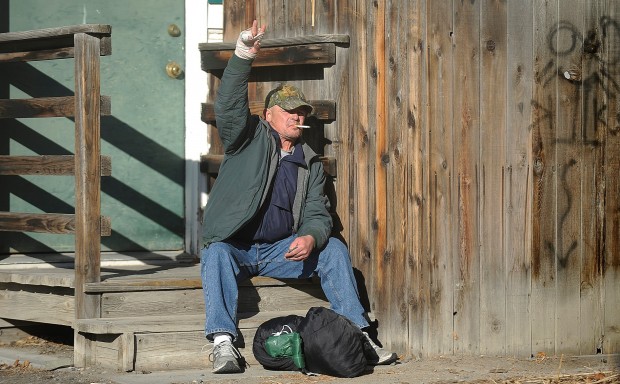
 DAVID GRUBBS/Gazette Staff Jerry “Chilli” Baggerman waves to a passing motorist from a
favorite sleeping spot behind a downtown restaurant. Baggerman,
who’s been homeless for the last 14 years, is among the hundreds of
people in Billings who have no home.


Ask 57-year-old Billings native Paul Sorensen where he will sleep tonight and he points — here, there and everywhere.
He has been homeless since he ran away at age 13. Talkative and carrying the sweet scent of cheap alcohol, Sorensen said he wants people to know that "we're here."
"A lot of people are concerned," he said, nodding his head. "But a lot of people have no idea. Every day we wake up, we win."
He mostly lives in an abandoned shack near the county jail. On really cold days, he and his brother, also homeless, can spend the night at a cousin's place.
"But there are a lot of people out here with no place to go," he said.
Like many in his predicament, he does odd jobs for spending money.
"Give us a sidewalk to shovel, give us a windshield to wash," he said. "We're homeless, not helpless."
No two stories are alike — every path to homelessness is different.
"Sometimes it's the little things that can lead to an unraveling," said Adela Awner, executive director of Billings Interfaith Hospitality Network. "Hours get cut at work, or they've lost daycare because of a shift change. A few days' illness and a few days' lost wages and they can't make the rent."
Poor and lower-income people tend to spend 50 percent or more of their income on housing, she said. That puts them at greater risk when something goes wrong — a car breaks down or an unexpected medical problem arises. With no resources in reserve, homelessness is just a small emergency away.
According to the 2010 Census, one in three Americans now is either classified as poor or low income. Low income is defined as those earning between 100 and 200 percent of the poverty level. For a family of four, the poverty level is an income of $22,113. The low-income threshold is around $45,000 for the same family. Data from the 2010 Census show the median household income in Montana is $42,222 compared with the national average of $50,221.
Living in Montana isn't cheap, either. The estimated cost of living in 2010 was 102.6 percent of the national average.
Low-income Americans are less likely to have medical insurance and more likely to be living paycheck to paycheck. It doesn't take much to topple into homelessness.
"It's not about 'these' people," said Gwynn Pederson, of the Billings Mental Health Center. "It's about us. It could happen to any of us."
Stephan Larsen, who worked at the Montana Rescue Mission before becoming homeless because a back injury made it impossible to work, has gained insight from a broad perspective in the past couple of years.
"I learned that not all people were at the Rescue Mission because of drugs and alcohol," he said. "These are people with some kind of trauma in their life."
Larsen recalls one man in the shelter who had lost his family in a house fire.
"He just couldn't cope with the tragedy," he said.
Annual surveys in Billings say the No. 1 cause of homelessness here is substance abuse. Second on the list is unemployment. Mental health issues rank third. The studies also confirmed a direct correlation between fewer years of formal education and increased risk of homelessness.
Those who work with the homeless in Billings emphasize that the majority are homegrown. A 2010 survey showed that 21 percent have lived here all their lives. About 60 percent have been here two to 10 years.
"This is not a transient population," said Lynda Woods, homeless liaison for the city of Billings.
Although 55 percent have a high school education, more in the homeless population may have learning disabilities or other impairments that interfere with the ability to read and write.
Twenty-seven percent of the homeless are employed, but don't make enough money to keep a roof over their heads. Fifty-five percent are white and 29 percent are American Indian. Most, 66 percent, are between the ages of 30 and 59. Twenty-seven percent are 18 to 29 years old. Men outnumber women 56 to 44 percent.
The number of veterans who are homeless has gone down, but the number of families without a permanent place to stay is up, local agencies say.
Sue Runkle, homeless education liaison for Billings public schools, said she sees the trend across the K-12 spectrum.
"Last year the cumulative total of homeless kids in the district was 466," she said. "This year so far we have 331. That's 20 more than we had last year at this time."
While some of the older students live on their own, often couch surfing and sometimes living in cars and on the streets, most are with their families in shelters or doubled up with relatives.
"They've been called America's invisible children," she said. "People don't realize they are homeless."
Copyright 2012 The Billings Gazette. All rights reserved. This material may not be published, broadcast, rewritten or redistributed.He has been homeless since he ran away at age 13. Talkative and carrying the sweet scent of cheap alcohol, Sorensen said he wants people to know that "we're here."
"A lot of people are concerned," he said, nodding his head. "But a lot of people have no idea. Every day we wake up, we win."
He mostly lives in an abandoned shack near the county jail. On really cold days, he and his brother, also homeless, can spend the night at a cousin's place.
"But there are a lot of people out here with no place to go," he said.
Like many in his predicament, he does odd jobs for spending money.
"Give us a sidewalk to shovel, give us a windshield to wash," he said. "We're homeless, not helpless."
No two stories are alike — every path to homelessness is different.
"Sometimes it's the little things that can lead to an unraveling," said Adela Awner, executive director of Billings Interfaith Hospitality Network. "Hours get cut at work, or they've lost daycare because of a shift change. A few days' illness and a few days' lost wages and they can't make the rent."
Poor and lower-income people tend to spend 50 percent or more of their income on housing, she said. That puts them at greater risk when something goes wrong — a car breaks down or an unexpected medical problem arises. With no resources in reserve, homelessness is just a small emergency away.
According to the 2010 Census, one in three Americans now is either classified as poor or low income. Low income is defined as those earning between 100 and 200 percent of the poverty level. For a family of four, the poverty level is an income of $22,113. The low-income threshold is around $45,000 for the same family. Data from the 2010 Census show the median household income in Montana is $42,222 compared with the national average of $50,221.
Living in Montana isn't cheap, either. The estimated cost of living in 2010 was 102.6 percent of the national average.
Low-income Americans are less likely to have medical insurance and more likely to be living paycheck to paycheck. It doesn't take much to topple into homelessness.
"It's not about 'these' people," said Gwynn Pederson, of the Billings Mental Health Center. "It's about us. It could happen to any of us."
Stephan Larsen, who worked at the Montana Rescue Mission before becoming homeless because a back injury made it impossible to work, has gained insight from a broad perspective in the past couple of years.
"I learned that not all people were at the Rescue Mission because of drugs and alcohol," he said. "These are people with some kind of trauma in their life."
Larsen recalls one man in the shelter who had lost his family in a house fire.
"He just couldn't cope with the tragedy," he said.
Annual surveys in Billings say the No. 1 cause of homelessness here is substance abuse. Second on the list is unemployment. Mental health issues rank third. The studies also confirmed a direct correlation between fewer years of formal education and increased risk of homelessness.
Those who work with the homeless in Billings emphasize that the majority are homegrown. A 2010 survey showed that 21 percent have lived here all their lives. About 60 percent have been here two to 10 years.
"This is not a transient population," said Lynda Woods, homeless liaison for the city of Billings.
Although 55 percent have a high school education, more in the homeless population may have learning disabilities or other impairments that interfere with the ability to read and write.
Twenty-seven percent of the homeless are employed, but don't make enough money to keep a roof over their heads. Fifty-five percent are white and 29 percent are American Indian. Most, 66 percent, are between the ages of 30 and 59. Twenty-seven percent are 18 to 29 years old. Men outnumber women 56 to 44 percent.
The number of veterans who are homeless has gone down, but the number of families without a permanent place to stay is up, local agencies say.
Sue Runkle, homeless education liaison for Billings public schools, said she sees the trend across the K-12 spectrum.
"Last year the cumulative total of homeless kids in the district was 466," she said. "This year so far we have 331. That's 20 more than we had last year at this time."
While some of the older students live on their own, often couch surfing and sometimes living in cars and on the streets, most are with their families in shelters or doubled up with relatives.
"They've been called America's invisible children," she said. "People don't realize they are homeless."
Lorna Thackeray can be reached at 657-1314 or lthackeray@billingsgazette.com
Posted in Local, Top-headlines on Sunday, January 8, 2012 12:15 am Updated: 7:18 am. | Tags: P.a.t.h., The Hub, Hub, Paul Sorensen, Homeless, Homelessness, Interfaith Hospitality Network, U.s. Census 2010, Gwynn Pederson, Billings Mental Health Center, Stephan Larsen, Lynda Woods, Sue Runkle,


